 USA:
USA:  India:
 (And Why the Shift from “Websites” to “Systems” Is Changing Everything)
In 2026, New Zealand businesses will no longer select web development companies based only on design, pricing, or past portfolios. They are choosing partners who can build AI-driven digital systems that continuously improve performance, adapt to user behavior, and deliver measurable business outcomes over time.
What’s Really Happening on the Ground
If you speak to business owners across Auckland, Wellington, or Christchurch, a pattern starts to emerge.
The process of hiring a web development company hasn’t become easier. It has become more complex.
There are more options than ever.
More agencies claiming AI expertise.
More promises around performance and growth.
And yet, despite all this, many businesses still end up with the same outcome:
A website that looks good, functions properly, but fails to deliver consistent results.
This disconnect is not because there is a lack of capable companies.
It is because the decision-making model businesses are using is outdated.
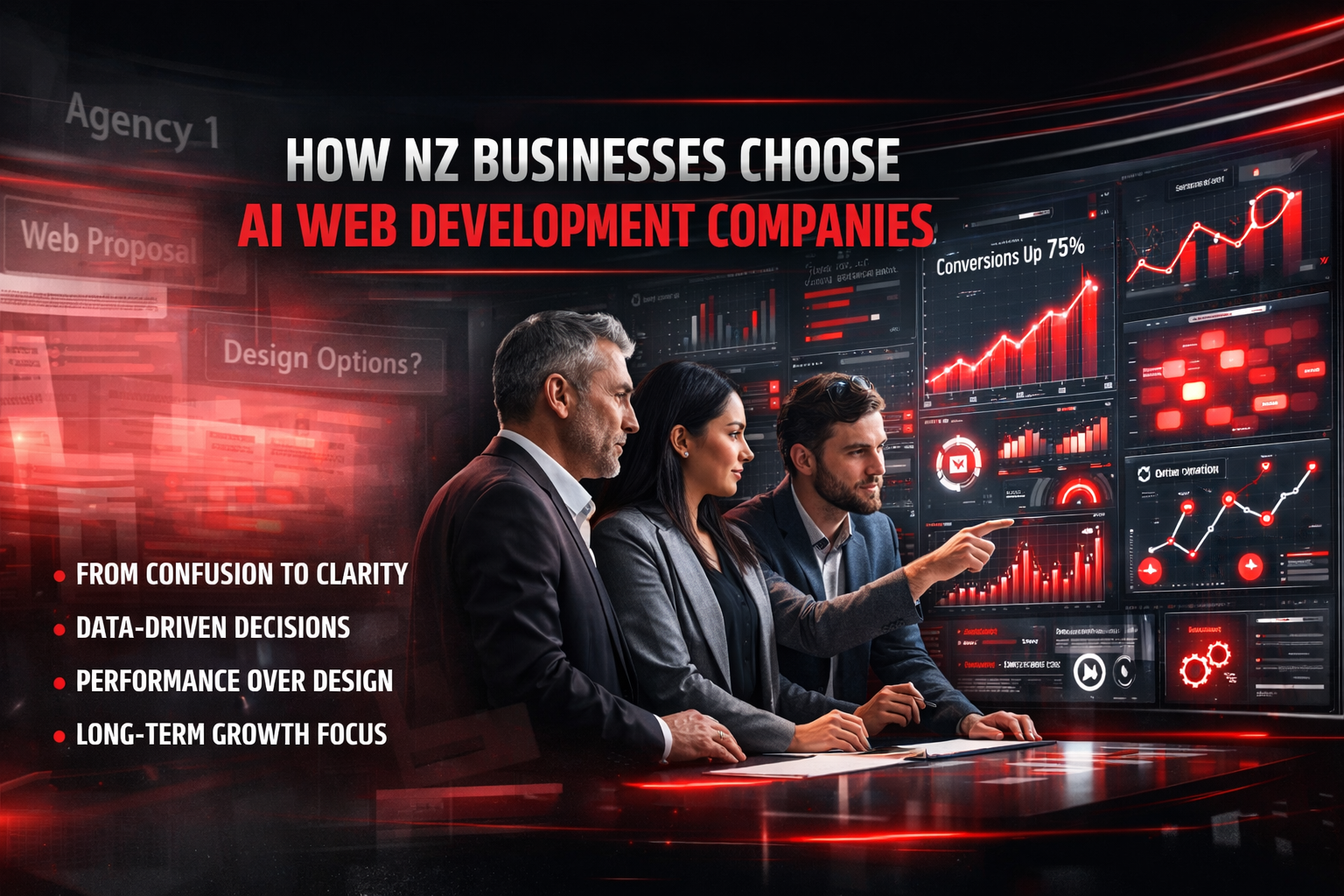
The Real Shift: From Buying Websites to Building Growth Systems
For years, businesses approached web development as a one-time project.
You define requirements.
You hire a team.
You build the website.
You launch it.
And then you expect it to perform.
That approach is now fundamentally flawed.
In 2026, high-performing New Zealand businesses are thinking differently. They are not investing in “websites.” They are investing in digital systems that evolve over time.
Let’s break that down clearly.
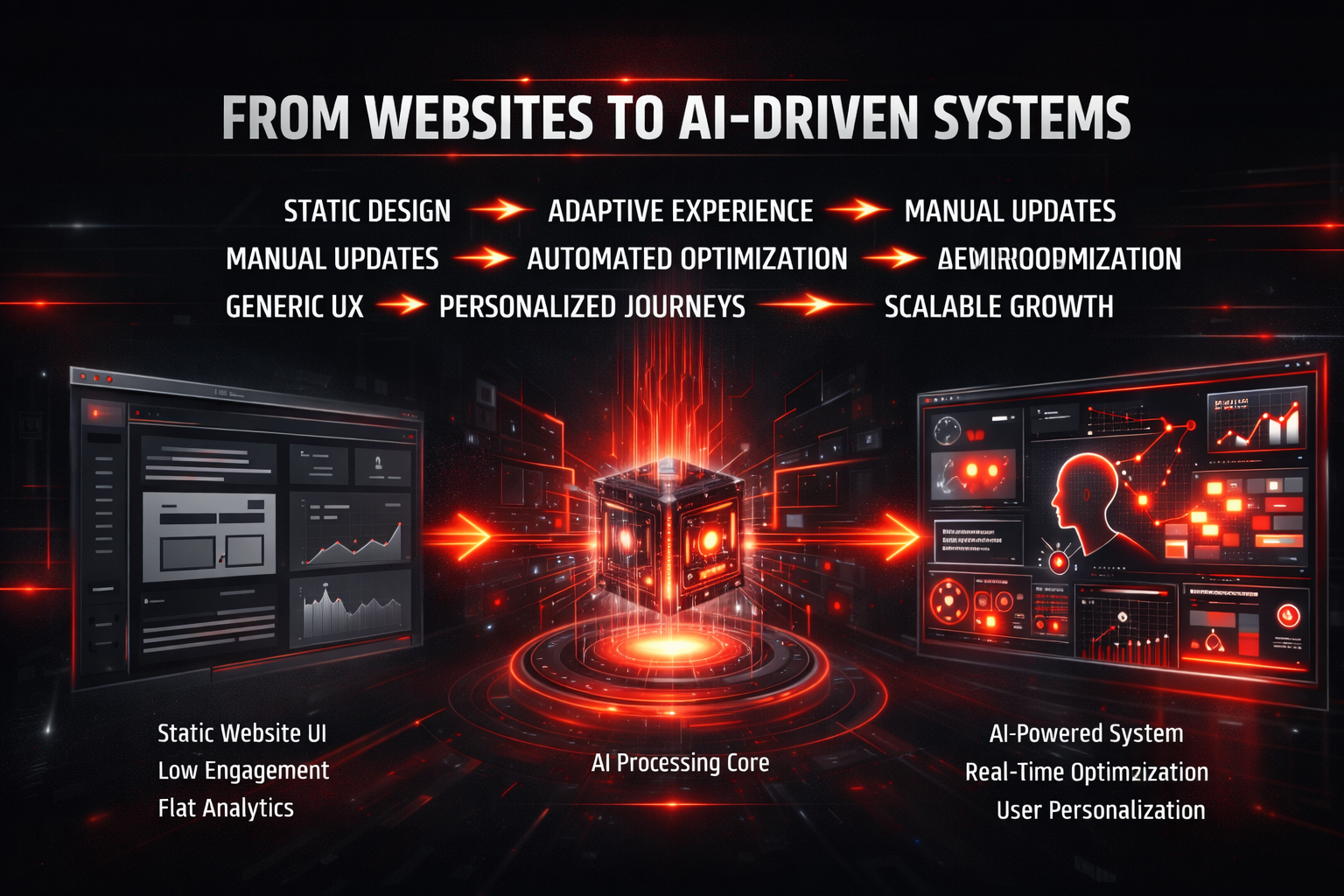
Old Thinking vs New Thinking
| Traditional Approach | AI-First Approach |
| Website as a project | Website as a system |
| Focus on design | Focus on performance |
| One-time delivery | Continuous improvement |
| Manual updates | Automated optimization |
| Generic experience | Personalized journeys |
This shift is subtle, but it completely changes how businesses evaluate and select development partners.
What the Selection Process Actually Looks Like in 2026
Let’s walk through how NZ businesses are actually making this decision today, not how most blogs say they should.
Stage 1: The Research Phase (Where Confusion Begins)
At this stage, businesses start searching for:
- best AI web development company in NZ
- AI website development services
- top web developers
They encounter:
- agencies claiming AI expertise
- freelancers offering low-cost solutions
- offshore companies promising fast delivery
The problem is not a lack of options.
The problem is a lack of clarity.
Most businesses still don’t fully understand:
- what AI web development actually means
- what impact should it have on performance
- how to evaluate real capability vs marketing claims
Stage 2: Shortlisting (Where Old Habits Take Over)
Even in 2026, many businesses fall back on traditional evaluation criteria:
- portfolio quality
- pricing
- design aesthetics
- brand reputation
While these factors still matter, they are no longer sufficient.
What gets missed here is:
- how the website will perform after launch
- whether AI is actually integrated or just mentioned
- how optimization will be handled over time
This is where many decisions quietly go wrong.
Stage 3: The Decision (Comfort Over Strategy)
When it comes to the final choice, businesses often prioritize:
- The company that communicates well
- the one that feels “safe.”
- or the one that fits the budget
This is human, and understandable.
But it leads to a critical gap.
The decision is based on delivery confidence, not performance capability.
Stage 4: Post-Launch Reality (Where the Gap Becomes Visible)
This is where the difference between traditional and AI-first companies becomes obvious.
Many businesses experience:
- stable but flat performance
- limited improvement in conversions
- lack of data-driven insights
- minimal post-launch support
At this point, the realization sets in:
The website works, but it does not grow.
What High-Performing Businesses Are Doing Differently
The top-performing companies in New Zealand have adjusted their approach.
They are no longer asking:
- “Who can build our website?”
They are asking:
- “Who can build a system that improves our business over time?”
This leads to a completely different evaluation framework.
The 2026 Evaluation Framework (What Actually Matters Now)
Here is how strategic businesses are selecting AI web development companies today:
| Factor | What They Evaluate | Why It Matters |
| AI Capability | Real integration into workflows | Drives automation and insights |
| Performance Strategy | Conversion and user journey focus | Impacts revenue directly |
| Data Infrastructure | Tracking, analytics, reporting | Enables continuous improvement |
| Scalability | Ability to evolve with business growth | Prevents future rebuilds |
| Support Model | Ongoing optimization and updates | Ensures long-term ROI |
This is a shift from checking features → evaluating outcomes.
The Role of AI in This Decision
AI is often misunderstood in this context.
It is not about adding chatbots or automation tools for the sake of it.
It is about enabling:
- real-time user behavior analysis
- predictive decision-making
- dynamic content delivery
- continuous performance optimization
When used correctly, AI changes the entire lifecycle of a website.
Business Impact: From Cost Center to Growth Engine
Let’s translate this into business terms.
Traditional Website
- upfront investment
- limited ROI visibility
- performance depends on manual updates
AI-Driven Website System
- ongoing performance improvement
- measurable conversion growth
- data-driven decision-making
Performance Comparison
| Metric | Traditional Website | AI-Powered System |
| Conversion Rate | Static | Continuously optimized |
| User Experience | Same for all users | Personalized |
| Growth | Linear | Compounding |
| ROI | Unclear | Measurable |
This is why businesses are rethinking how they choose development partners.
Where Many Businesses Still Go Wrong
Despite this shift, common mistakes continue to happen.
1. Treating AI as a Feature
Instead of seeing it as a system-level capability.
2. Focusing on Price Over Value
Lower cost often leads to limited long-term performance.
3. Ignoring Post-Launch Strategy
Assuming the job ends after delivery.
4. Overvaluing Design Alone
A visually appealing site without a performance strategy rarely converts.
How ZTS Infotech Pvt Ltd Aligns with This Shift
For businesses navigating this transition, the key is to work with a partner that understands both technology and business outcomes.
ZTS Infotech Pvt Ltd operates with a system-first approach.
What This Means in Practice
- websites are designed with user journey clarity
- development focuses on performance and scalability
- AI integration supports ongoing optimization
- processes are structured from planning to post-launch
Service Alignment
Website Design
Built around user behavior, not just visuals.
WordPress Development
Structured for speed, scalability, and easy management.
E-commerce Development
Focused on conversion optimization and revenue growth.
Shopify Development
Optimized for faster transactions and improved user flow.
Full Stack Development
Flexible solutions that support long-term scalability.
Process Transparency: How It Should Work
A structured process is critical for consistent outcomes.
1. Planning
Understanding business goals and defining measurable outcomes.
2. Design
Creating layouts focused on usability and conversion.
3. Development
Building scalable and performance-oriented systems.
4. Testing
Ensuring speed, functionality, and compatibility.
5. Launch
Deploying with proper monitoring in place.
6. Continuous Optimization
Improving performance based on real data.
Why This Matters for NZ Businesses
New Zealand’s digital landscape is becoming more competitive.
Businesses are dealing with:
- higher customer acquisition costs
- increased online competition
- rising expectations for speed and personalization
In this environment, a static website becomes a liability.
A system that improves over time becomes an advantage.
FAQs
1.Is AI web development suitable for small businesses?
Yes, especially because it improves efficiency and reduces long-term costs.
2.How long does it take to build an AI-powered website?
Basic systems can take a few weeks, while more advanced platforms may take longer, depending on complexity.
3.Is offshore development reliable?
It depends on the process, communication, and experience of the partner.
4.How do I know if a company truly uses AI?
Look for how AI is integrated into workflows, not just mentioned as a feature.
Final Perspective
The way NZ businesses select web development companies is changing, but not fast enough.
Many are still using outdated criteria to make modern decisions.
The result is predictable.
Websites that look complete but fail to perform.
The real shift is not about choosing between local or offshore, expensive or affordable.
It is about understanding this:
- You are not investing in a website.
- You are investing in a system that should grow your business.
And the companies that recognize this will consistently outperform those that do not.
Ready to Make a Smarter Decision?
If you are evaluating your next web development move, start by redefining what success looks like.
Clarity at the beginning can prevent costly mistakes later.
And in 2026, that clarity is what separates businesses that grow from those that stay stuck.
-

Writen by Anirban Das
