 USA:
USA:  India:
 .png)
The eCommerce Landscape Is Shifting — Are You Keeping Up?
Cast your mind back five years. Running a WooCommerce store meant obsessing over plugin conflicts, manually tweaking product descriptions, and hoping your customers could find what they were looking for without giving up and heading to Amazon. Today, that picture looks entirely different — and for UK businesses willing to embrace it, the opportunity is enormous.
Artificial intelligence has quietly moved from being a Silicon Valley buzzword to a genuine, practical toolkit for eCommerce businesses of every size. Whether you're running a boutique homewares brand from Bristol or scaling a fashion reseller out of Manchester, AI WooCommerce development services are no longer a luxury reserved for enterprise budgets. It's becoming the baseline expectation for competitive online retail.
The UK eCommerce market surpassed £120 billion in annual sales in recent years, and competition for consumer attention has never been fiercer. AI isn't just helping businesses keep up — it's helping the smart ones pull ahead. It's no surprise, then, that demand for AI WooCommerce development services in the UK has grown sharply as retailers look for every edge they can find. Here's what that actually looks like in practice.
What Does AI in WooCommerce Development Actually Mean?
Let's clear something up straight away: AI WooCommerce development services aren't about replacing your developers with robots or handing your entire store over to an algorithm. It's about layering intelligence into the systems you already rely on — so your store works smarter, responds faster, and sells more effectively.
In practical terms, this encompasses a broad range of capabilities:
- Intelligent product recommendations that learn from individual browsing and purchase behaviour
- AI-powered chatbots and virtual assistants that handle customer queries around the clock
- Predictive inventory and demand forecasting tools integrated directly into your WooCommerce back-end
- Dynamic pricing engines that adjust in real time based on demand, competitor activity, and stock levels
- Automated content generation for product descriptions, metadata, and category pages
- Fraud detection and smart checkout flows that reduce cart abandonment and chargebacks
The magic isn't in any single feature — it's in how these capabilities work together, feeding data back and forth to create a store that genuinely learns over time.
Key Benefits of AI for WooCommerce Stores
Personalisation That Actually Converts
Generic product grids are a relic of early-2000s eCommerce. Modern shoppers — particularly the UK's increasingly discerning online buyers — expect relevance. AI enables WooCommerce stores to surface the right products to the right customer at the right moment, based on real behavioural signals rather than broad demographic guesses.
Stores using AI-driven personalisation typically see meaningful lifts in average order value and repeat purchase rates. When a returning customer lands on your site and immediately sees products aligned with their taste and history, the journey from browse to checkout shortens considerably.
Always-On Customer Support Without the Overhead
Staffing a customer service team to cover evenings, weekends, and bank holidays is expensive — and for small to mid-sized UK businesses, often not feasible. AI chatbots integrated into WooCommerce can handle the majority of routine queries (order status, returns policy, sizing queries, shipping estimates) instantly and accurately, escalating to a human only when the situation genuinely warrants it.
The best implementations don't feel like talking to a bot at all. They're contextual, conversational, and — crucially — available when your customers actually want to shop.
Smarter Inventory and Fewer Stockouts
Getting caught with empty shelves on a bestselling product, or worse, over-ordering slow-moving stock that ties up cash flow — these are problems every product-based business knows intimately. AI-driven demand forecasting, integrated directly into WooCommerce inventory management, can analyse historical sales patterns, seasonal trends, and even external signals (weather, local events, cultural moments) to give you far more reliable restocking guidance.
Reduced Fraud and Abandoned Carts
Payment fraud costs UK businesses hundreds of millions each year. AI-powered fraud detection tools can analyse transaction signals in real time, flagging suspicious activity without creating unnecessary friction for legitimate customers. Meanwhile, intelligent cart recovery tools — triggered by AI-analysed exit intent — can bring back shoppers who were on the fence, through timely, personalized follow-ups.
Real Use Cases of AI in UK eCommerce
A London Fashion Retailer Cuts Return Rates
One of the most common challenges for UK clothing retailers is the high volume of returns driven by poor sizing decisions. By integrating an AI-powered size recommendation engine into their WooCommerce store — one that asks customers a few quick questions about fit preferences and body measurements — a mid-sized London-based retailer saw return rates drop significantly within the first quarter. Fewer returns meant lower logistics costs, better margin, and happier customers.
A Yorkshire-Based Health Brand Personalises at Scale
A direct-to-consumer supplements brand from Leeds used AI recommendation logic to build what they called a "personal nutritionist" experience on their WooCommerce site. Rather than showing every visitor the same product catalogue, the site guided users through a short lifestyle quiz and then populated the shop with products relevant to their goals. Conversion rates improved, but more importantly, subscription retention increased — because customers felt the brand understood them.
An Edinburgh Electronics Reseller Automates Product Content
Keeping product listings accurate, optimised, and engaging across a catalogue of thousands of SKUs is a near-impossible task manually. An Edinburgh-based electronics reseller used AI content generation tools — integrated with their WooCommerce product database — to automatically produce and update product descriptions, meta titles, and structured data at scale. The result was a measurable improvement in organic search visibility without proportional increases in content team headcount.
Why UK Businesses Need AI WooCommerce Experts — Not Just Generalists
Here's where many businesses come unstuck. The WooCommerce plugin ecosystem is vast, and there's no shortage of developers who can install a plugin and call it "AI integration." But genuinely transformative results come from AI WooCommerce experts UK retailers increasingly seek out — professionals who understand both the technical architecture of WooCommerce and the strategic application of AI within it.
The distinction matters enormously. A seasoned AI WooCommerce expert will:
- Audit your current store and identify where AI will genuinely move the needle (rather than adding complexity for its own sake)
- Select and configure tools that integrate cleanly with your existing stack — without slowing down site performance or creating security vulnerabilities
- Build custom solutions where off-the-shelf plugins fall short
- Ensure GDPR compliance and responsible data handling, which is non-negotiable in the UK market
- Provide ongoing optimisation as your AI models learn and improve over time
The UK has its own specific regulatory and consumer landscape. Working with AI WooCommerce experts UK businesses trust means you're working with people who understand ICO requirements, UK-specific consumer behaviour patterns, and the nuances of serving a British audience — rather than retrofitting advice designed for the US market.
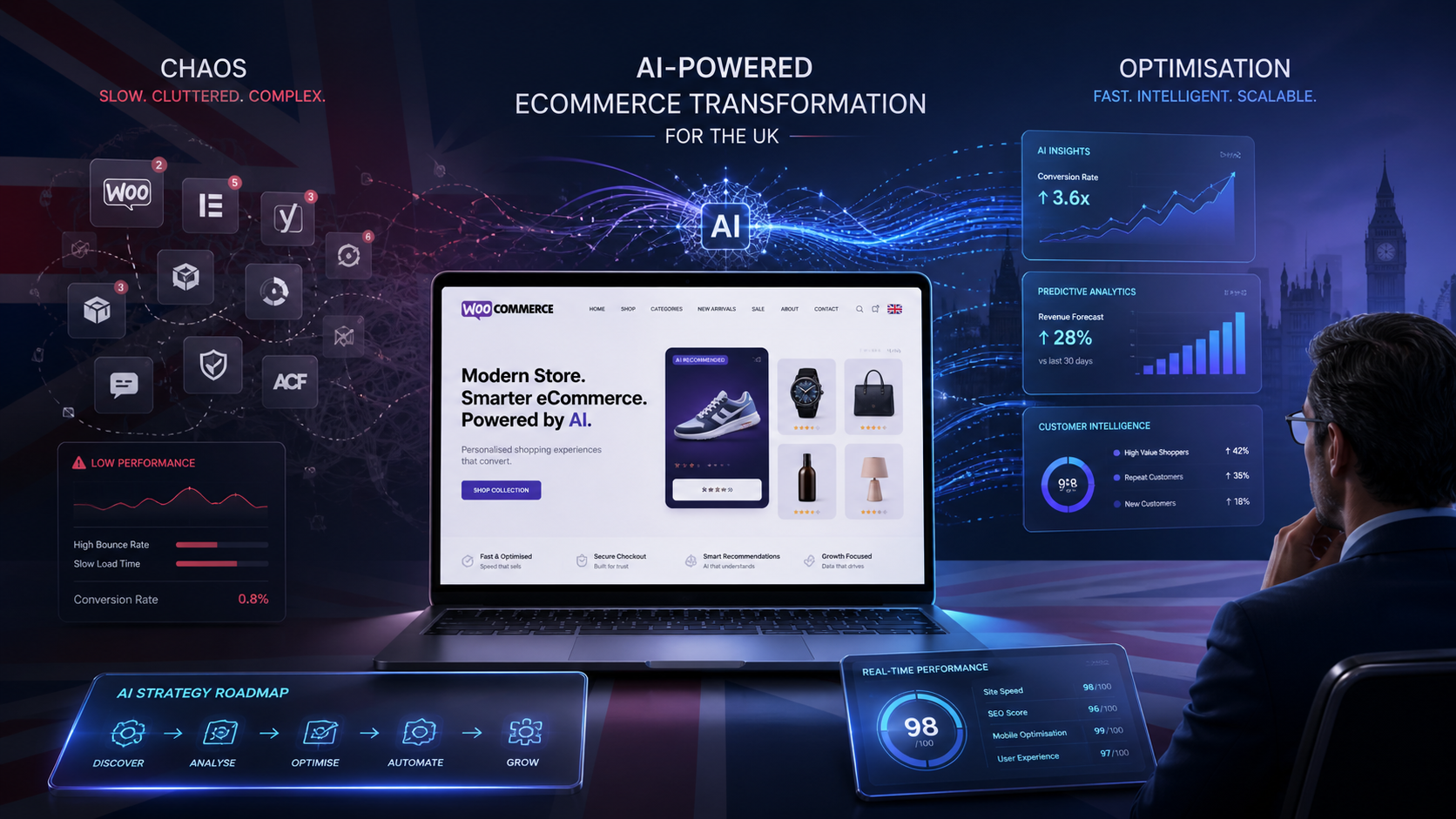
Choosing the Right AI WooCommerce Development Services
When evaluating AI WooCommerce development services, there are a few things worth looking out for beyond a polished portfolio.
Ask about measurable outcomes. A good partner should be able to point to real results — not just implementations. Conversion rate lifts, cart abandonment reductions, support ticket volumes, organic traffic growth. These are the metrics that matter.
Assess their understanding of your sector. A team that's worked with fashion retailers will bring different insight than one that's deep in B2B wholesale. Sector experience shapes how AI solutions are designed and deployed.
Look for a strategic partner, not just a build shop. The most valuable AI WooCommerce relationships are ongoing. AI systems improve with time and data, and having a partner who continues to refine and optimise your implementation is far more valuable than a one-off project delivery.
Prioritise transparency. You should understand what your AI tools are doing, why they're making the recommendations they are, and how your customer data is being used. A reputable development partner will insist on this clarity, not obscure it.
The Future of AI in WooCommerce: A UK Perspective
The trajectory is clear, and it's accelerating. In the near term, we'll see AI move deeper into WooCommerce's core workflows — from visual search (letting customers upload a photo to find similar products) to AI-driven A/B testing that optimises page layouts and copy in real time without a developer touching the code.
Voice commerce is also on the horizon. As smart speakers and voice assistants become more embedded in UK households, WooCommerce stores that are built with voice-accessible product data and conversational commerce in mind will be far better positioned than those that aren't.
Perhaps most significantly, AI will continue to democratise capabilities that were once reserved for retailers with deep tech teams and enterprise budgets. The small independent UK retailer will increasingly be able to deliver an experience that rivals the personalisation sophistication of far larger competitors — if they choose the right partners to help them get there.
Frequently Asked Questions About AI WooCommerce Development
How much does AI WooCommerce development cost for a small UK business?
Costs vary considerably depending on the scope of integration, but it's worth reframing the question slightly. Rather than asking how much it costs, it's more useful to ask what it costs not to — in lost conversions, manual overhead, and missed personalisation opportunities. That said, not every AI integration requires a five-figure budget. Many businesses accessing AI WooCommerce development services in the UK start with targeted, high-impact additions (such as an AI chatbot or a product recommendation engine) for a few thousand pounds, then build from there as they see returns. A good development partner will help you prioritise based on where AI will deliver the fastest, most measurable ROI for your specific store.
Do I need to completely rebuild my WooCommerce store to use AI?
Not at all. One of the genuine strengths of WooCommerce's architecture is how well it accommodates layered integrations. In most cases, AI capabilities are added on top of your existing store — through custom plugins, API connections, or third-party tools configured to your requirements. A full rebuild is rarely necessary, and any partner suggesting otherwise without a compelling technical reason should be questioned. The goal should be augmenting what's working, not discarding it.
Will AI tools slow down my WooCommerce site?
They shouldn't, provided they're implemented correctly. Performance impact is a legitimate concern — poorly configured third-party scripts and bloated plugins are a common cause of WooCommerce slowdowns. However, a competent AI WooCommerce development team will ensure that integrations are optimised for speed, that heavy processing happens server-side rather than in the browser, and that Core Web Vitals are monitored throughout. In some cases, AI-driven performance tools actually improve site speed by intelligently caching content and optimising delivery.
Is AI in WooCommerce GDPR compliant?
It can and must be. GDPR compliance isn't optional for UK businesses, regardless of whether AI is involved — and the introduction of AI tools doesn't create a compliance exemption. What it does create is additional responsibility around how customer data is collected, processed, and stored. AI recommendation engines, chatbots, and behavioural tracking tools all need to be configured with data minimisation principles in mind, and customers must have clear visibility into how their data is being used. Working with a UK-based development partner who understands ICO requirements and builds compliance into the architecture from the start is essential — not an afterthought.
Can AI actually improve SEO for my WooCommerce store?
Yes, meaningfully so. AI contributes to WooCommerce SEO in several ways: automating the generation and optimisation of product metadata and descriptions at scale, identifying content gaps based on search intent data, improving site structure and internal linking logic, and enhancing page speed (which is a direct ranking factor). AI tools can also support structured data implementation — helping search engines better understand your product catalogue and increasing the likelihood of rich results appearing in search pages. It's not a replacement for a solid SEO strategy, but it's a powerful accelerant for one.
How long does it take to see results from AI WooCommerce integrations?
Some benefits are near-immediate — a well-configured AI chatbot, for instance, will start deflecting routine support queries from day one. Others, particularly those that rely on machine learning models building up a picture of your customers' behaviour (like personalisation engines or demand forecasting tools), improve progressively over weeks and months as they accumulate data. It's reasonable to expect meaningful, measurable improvements within the first one to three months for most implementations, with performance continuing to compound as the systems mature. Setting realistic expectations upfront, and agreeing on the KPIs you'll measure against, is something a reputable development partner should do before any work begins.
What's the difference between an AI chatbot and a standard live chat plugin?
A standard live chat plugin connects your customers to a human agent — useful, but limited by your team's availability and capacity. An AI chatbot, by contrast, operates autonomously, handling queries 24/7 without human intervention. The better ones are trained on your specific product catalogue, returns policy, shipping information, and FAQs, making them genuinely useful rather than frustrating. Crucially, they can also be integrated with your WooCommerce order management system — so a customer asking "where's my order?" gets a real, accurate answer rather than a generic holding response. The two approaches aren't mutually exclusive; the most effective setups use AI to handle the majority of queries automatically, escalating to a human only when the situation genuinely warrants it.
Conclusion: The Best Time to Start Is Now
AI isn't a future consideration for UK WooCommerce businesses — it's a present-tense competitive reality. The brands investing in intelligent eCommerce infrastructure today are the ones building the customer loyalty, operational efficiency, and revenue foundations that will define their position in the market for years to come.
The encouraging news is that you don't need to overhaul your entire operation overnight. Smart, phased AI integration — starting with the areas of highest impact for your specific store — can deliver meaningful results relatively quickly, and each improvement compounds over time as your systems learn.
If you're ready to explore what AI WooCommerce development services in the UK could look like for your business, our team specialises in exactly this space. Take a look at our AI website engineering services to find out how we work with UK businesses to build smarter, more profitable eCommerce experiences — without the jargon or the guesswork.
-

Writen by Anirban Das
