 USA:
USA:  India:
 When hiring a Flutter Developer in KSA, enterprise clients will be looking at two options: hiring a local freelancer or working with a structured development team able to deliver cross-functional capabilities. Flutter is Google’s open-source UI framework thatallows developers to create applications for Android, iOS, and the web from one code base. Businesses in KSA that are targeting mobile-first, bilingual users benefit from reduced build times and reduced cost of ownership but do not compromise on performance by using Flutter. Projects timelines will typically be between 8 and 20 weeks depending on complexity and budgets will be based on the amount of integration required; however, all budgets will not only consider the cost of building out an application interface, but also the overall project scope.
The Mobile Reality in Saudi Arabia Right Now
In the world, Saudi Arabia's smartphone penetration rate is one of the highest, over 95%. Consumers located in Riyadh, Jeddah, and Dammam, expect fast and intuitive mobile experiences when ordering groceries, book services, or when they are doing B2B procurement. Vision 2030 is making this transition much quicker by pushing the Government's services, retail, healthcare, and logistics industries digitally first.
There are three primary situations when companies consider developing an app: developing a standalone iOS app and now cannot afford to build an Android app separately, launching a web app that is not functioning well on mobile or entering into a new market, and need a cross-platform solution that does not require creating two development teams for start-up companies.
With Flutter, the three app development projects mentioned above can be completed using one maintainable codebase. However, there are many more elements to consider than just choosing the framework when hiring a Flutter developer in Saudi Arabia. These developers have several options in terms of current business condition and the ultimate delivery of business outcomes with various engagement models.
What Flutter Development Actually Involves
Building an application with Flutter requires a thorough understanding of multiple disciplines and cannot be rushed or shortcut.
Flutter's flexible widget architecture allows developers to have pixel-perfect control over their app interface; however, it requires developers to make intentional design decisions. For example, if you were developing a bilingual Saudi app (Arabic going right to left; English going left to right), you would want to be sure you use a developer with experience developing applications for both directions and not just someone who changed a setting. A lot of times in Saudi Arabia, one of the common technical issues reported by users when commenting on an application that was built locally is poor implementation of right-to-left (RTL) functionality.
Backend and API Integration The app interface is roughly 30 percent of the actual build. The remainder involves API design, database architecture, authentication, and third-party integrations. In the Saudi context, this includes payment gateways such as HyperPay, Tamara, and Tabby, logistics APIs like Aramex and SMSA, and ZATCA-compliant invoicing for VAT requirements introduced under Phase 2 e-invoicing mandates.
State Management Flutter projects fail in production most commonly due to poor state management decisions made early. Whether using Provider, Riverpod, or BLoC depends on the application's complexity and the team's long-term maintenance plan. A freelance developer hired for speed will rarely document these architectural decisions, which creates problems when scaling or handing off the project.
Performance and Security Saudi enterprise clients and government-adjacent platforms require compliance with SDAIA's data protection regulations. If your app collects user data, processes payments, or connects to healthcare or financial systems, the developer you hire must understand both technical security implementation and local regulatory expectations.
Business Scenarios: When Flutter Makes Sense and When It Does Not
Retail and eCommerce A Riyadh retail business entering mobile commerce with a mid-size product catalog, Arabic and English interfaces, and Saudi payment integrations is a strong Flutter candidate. One codebase serves both iOS and Android, reducing the initial investment by 35 to 45 percent compared to native builds, while maintaining near-native performance for catalog browsing and checkout flows.
Service Booking and On-Demand Platforms Home services, healthcare appointments, beauty salons, and food delivery platforms in KSA have seen significant adoption growth. These applications need real-time updates, geolocation, and notification systems — all areas where Flutter performs reliably. The AI-powered layer often added here includes smart scheduling, demand prediction, and personalized service recommendations based on user history.
B2B and Enterprise Tools Internal tools for field teams, procurement approval systems, and logistics tracking dashboards are increasingly built in Flutter because of the cross-platform efficiency. A single app deployed to both the operations team's Android tablets and management's iPhones eliminates the dual-maintenance problem that plagues older enterprise mobile strategies.
Where Flutter Is Not the Right Answer If you are building a graphics-intensive game, a highly specialized AR application, or something deeply integrated with device-specific hardware, native development remains more appropriate. Flutter is excellent for business applications but does not replace native where platform-specific capabilities are the core product.
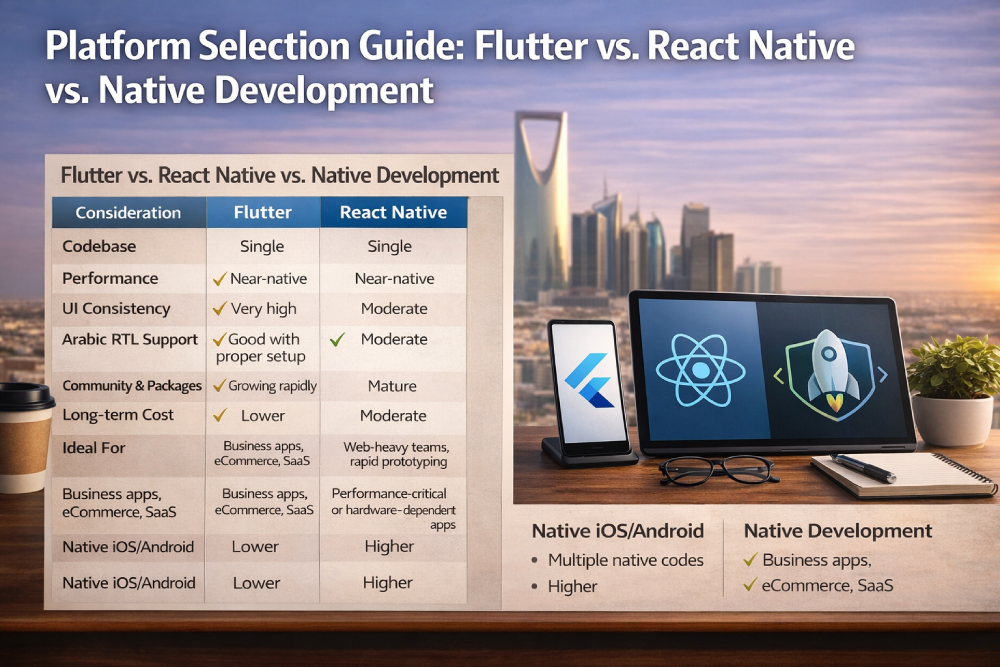
Platform Selection Guide: Flutter vs. React Native vs. Native Development
| Consideration | Flutter | React Native | Native iOS/Android |
| Codebase | Single | Single | Separate per platform |
| Performance | Near-native | Near-native | Native |
| UI Consistency | Very high | Moderate | Platform-specific |
| Arabic RTL Support | Good with proper setup | Moderate | Strong |
| Community & Packages | Growing rapidly | Mature | Mature |
| Long-term Cost | Lower | Moderate | Higher |
| Ideal For | Business apps, eCommerce, SaaS | Web-heavy teams, rapid prototyping | Performance-critical or hardware-dependent apps |
For most Saudi SMEs and growth-stage startups building customer-facing or operational apps, Flutter offers the strongest cost-to-performance ratio at this stage of the framework's maturity.
The Workflow Behind a Well-Executed Flutter Project
Understanding the delivery process helps you evaluate any development partner's credibility.
Discovery and Scoping (Week 1–2) This phase defines user journeys, platform integrations, Arabic/English requirements, and technical dependencies. Skipping this phase is the primary reason projects exceed budget or launch with the wrong features.
UX Planning and Wireframing (Week 2–3) Before any UI design begins, user flows are mapped against business objectives. For a service booking app, this means defining the exact steps from app open to confirmed booking and payment — and identifying where most users will drop off if the architecture is poor. The real issue is rarely the visual design. It is the conversion architecture beneath it.
UI Design (Week 3–5) Flutter design is built in Figma and converted to Flutter widgets. Bilingual design requires separate validation for both languages, especially for form layouts, buttons, and navigation patterns where Arabic text length differs from English.
Development (Week 5–14) Flutter development runs in sprints with milestone reviews. Core modules — authentication, product or service listing, cart or booking flow, payment integration, user profile — are built and tested independently before integration.
Testing (Week 14–16) Quality assurance covers device compatibility across common Android and iOS models used in Saudi Arabia, RTL/LTR rendering, payment gateway sandbox testing, and performance benchmarking. Accessibility testing against WCAG standards is increasingly requested by government and healthcare clients.
Launch and Post-Launch Optimization (Week 16–20) App Store and Google Play submissions require compliance documentation and metadata. Post-launch monitoring covers crash reporting, performance analytics, and user behavior data that informs the first optimization cycle.
AI-Powered Capabilities Worth Considering in Your Flutter App
Adding AI functionality to Flutter apps has moved from testing to become operationally viable for many Saudi organizations across multiple industries.
Personalized Merchandising Engines use user data to present appropriate products/services/content. The use of Information Extraction/NLP for Arabic search improves intent-driven arabic searches in far better way than merely searching for keywords in arabic. Predictable UX corrects user actions by pre-rendering screen requested by user and presenting recently used items. That leads to a measurable increase in how long users will stay on a session. Chatbots enable automated customer service via existing conversational engines, reducing high traffic service costs for consumer applications. Analytics dashboard gives navigation through all defined user types, their level of activity, and drop-off locations for retail owners.
None of these features should be added simply to see how cool they are; each should be used for an expected financial outcome and operational benefit, based on the level of development costs required.
What Affects the Cost of Hiring a Flutter Developer in Saudi Arabia
Pricing transparency matters, particularly for businesses that have received wildly inconsistent quotes from different vendors.
Scope of Integrations A basic Flutter app with static content and a contact form costs fundamentally less than one integrating ZATCA-compliant billing, three payment gateways, a loyalty program, and an Arabic NLP search engine. The integrations drive cost more than the app screens.
Design Complexity Custom illustration, animation, and branded interaction design require significantly more time than adapting a standard component library.
Backend Requirements If your app connects to an existing ERP, CRM, or inventory system, the API development and data migration work often exceeds the frontend build in time and complexity.
Team Structure A solo freelancer quotes less because they are doing everything themselves with no project management, no QA process, and no structured handoff documentation. A development company structures its pricing to cover discovery, design, development, testing, and deployment as distinct phases with accountable deliverables.
ZTS India structures its Flutter app development engagements with clear phase-based pricing. Entry-level packages for straightforward service apps begin around 749 SAR per month for managed development and maintenance engagements, with project-based pricing for full custom builds quoted after a discovery session. These figures are starting points for scoping conversations, not fixed catalog prices — every serious project requires a proper technical assessment before a responsible quote can be issued.
Why the Engagement Model Matters as Much as the Technology
Numerous businesses in Saudi Arabia have embarked on app development projects, ending up with a product they are unable to maintain, unable to update, and unable to transfer to a different vendor because of the lack of documentation and a clean codebase.
You should ask any development partner the following questions prior to executing an agreement:
What is the source code owner and repository at the conclusion of the project? You should own both of them; no conditions.
If you choose to bring development internally in the future or switch vendors, what is the handoff process? A quality partner will have an established method for offboarding.
How are defects from launch handled and for what duration? Warranty periods and SLA's for support should be documented.
What type of testing will occur before each production deployment? Ad hoc testing tends to be one of the best indicators of success post-launch.
Why Saudi Businesses Work with ZTS India
ZTS India provides web design, app development, and full-stack digital development services to clients in Saudi Arabia, UAE, Qatar, and globally. In addition to Flutter development, ZTS has a solid foundation to build websites on WordPress, shopify, create custom php applications, and engineer AI-based platforms. Our team has extensive experience developing Arabic bilingual applications, integrating local payment and logistics within Saudi Arabia, creating ZATCA compliant applications, and meeting the performance expectations of mobile users in the region (GCC). We complete all projects using a structured project management framework that includes periodic milestone reviews, ownership of the project's source code at the completion of the work is transferred to the client upon project completion, and we offer a variety of post-launch support options based on the client's operating budget for a growth-stage company.
Frequently Asked Questions
How long does it take to build a Flutter app for a Saudi business? Most business applications — service booking, eCommerce, B2B tools — take between 12 and 20 weeks from discovery to App Store launch. Complexity of integrations and design requirements are the primary variables.
Can a Flutter app handle Arabic and English equally well? Yes, when built by a team with RTL experience. Arabic support in Flutter requires deliberate implementation at the architecture level, not just UI toggling. Verify this with any team you evaluate by asking to see a deployed Arabic-language application they built.
Do I own the source code after the project? With ZTS India, full source code and repository ownership transfers to the client at project completion. Confirm this explicitly with any development partner before engagement.
What Saudi-specific integrations does Flutter support? Flutter applications can integrate HyperPay, Tamara, Tabby, Mada, STC Pay, Aramex, SMSA, and ZATCA e-invoicing systems through custom API development. These are not out-of-the-box Flutter features — they require backend development and gateway-specific testing.
Is Flutter suitable for enterprise-scale applications in KSA? Yes, for the majority of enterprise use cases including field operations, internal tools, procurement, HR self-service, and logistics tracking. Very high-frequency transactional platforms with millions of daily users may benefit from a native-first evaluation, but Flutter handles enterprise-scale business applications reliably.
What is the difference between hiring a freelance Flutter developer and a development company? A freelancer provides individual execution capacity. A development company provides a structured process, multiple specializations, QA, project management, and continuity if one team member is unavailable. For production applications that affect business operations, the process structure typically outweighs the cost difference.
How does ZTS India handle projects remotely for Saudi clients? Discovery and requirement sessions are conducted via video call with documentation shared in the client's preferred language. Milestone reviews, testing sign-offs, and launch coordination are managed through structured project management workflows. Time zone overlap with the GCC is managed within standard working hours.
Conclusion
Before hiring a Flutter developer in Saudi Arabia, assess the functional specifications of your application (the thing you want to build) and evaluate your internal capacity to manage the development process. Make sure to also consider your long-term vision for maintaining and expanding your platform.
For many Saudi companies developing mobile applications in 2025, Flutter will offer a very strong technology choice. The maturity of Flutter, the bilingual nature of Flutter, Flutter’s ability to create common applications for multiple platforms (cross-platform), and the rapid growth of the Flutter ecosystem (including integrations with Saudi companies) make it a logical default for developing mobile applications in the retail, service, healthcare, logistics and enterprise software sectors.
In comparison, selecting a development partner will have a greater long-term impact on your company than choosing a framework. When selecting a potential partner consider their level of transparency throughout the development process, their experience working with Arabic language interfaces and other integrations for the Saudi market, their policies regarding ownership of the code they write for you, and their ability to support your platform after it has launched.
If you are considering developing a Flutter App for your Saudi Arabian Company, you should schedule a Technical Discovery Session before securing an estimate from your Development Partner. A reputable Partner will not provide an estimate without this essential meeting.
Request a Free Project Consultation from ZTS India and share your app concept. The ZTS Team will provide you with a scalable evaluation including timelines and estimated investment.
-

Writen by Anirban Das
