 USA:
USA:  India:
 The Fastest Onboarding in Business History Took Ten Minutes and an Empty Folder
Most new hires need a week just to find the bathroom, let alone understand how a company actually runs. Anirban Das, presenting on ZTS Infotech's AI News Desk, says he onboarded a new team member in roughly ten minutes last week — no handbook, no forgotten instructions by Friday, no repeated corrections. The employee in question wasn't a person. It was Claude Code, Anthropic's AI coding agent, repurposed not to write software but to learn and audit how a business operates.
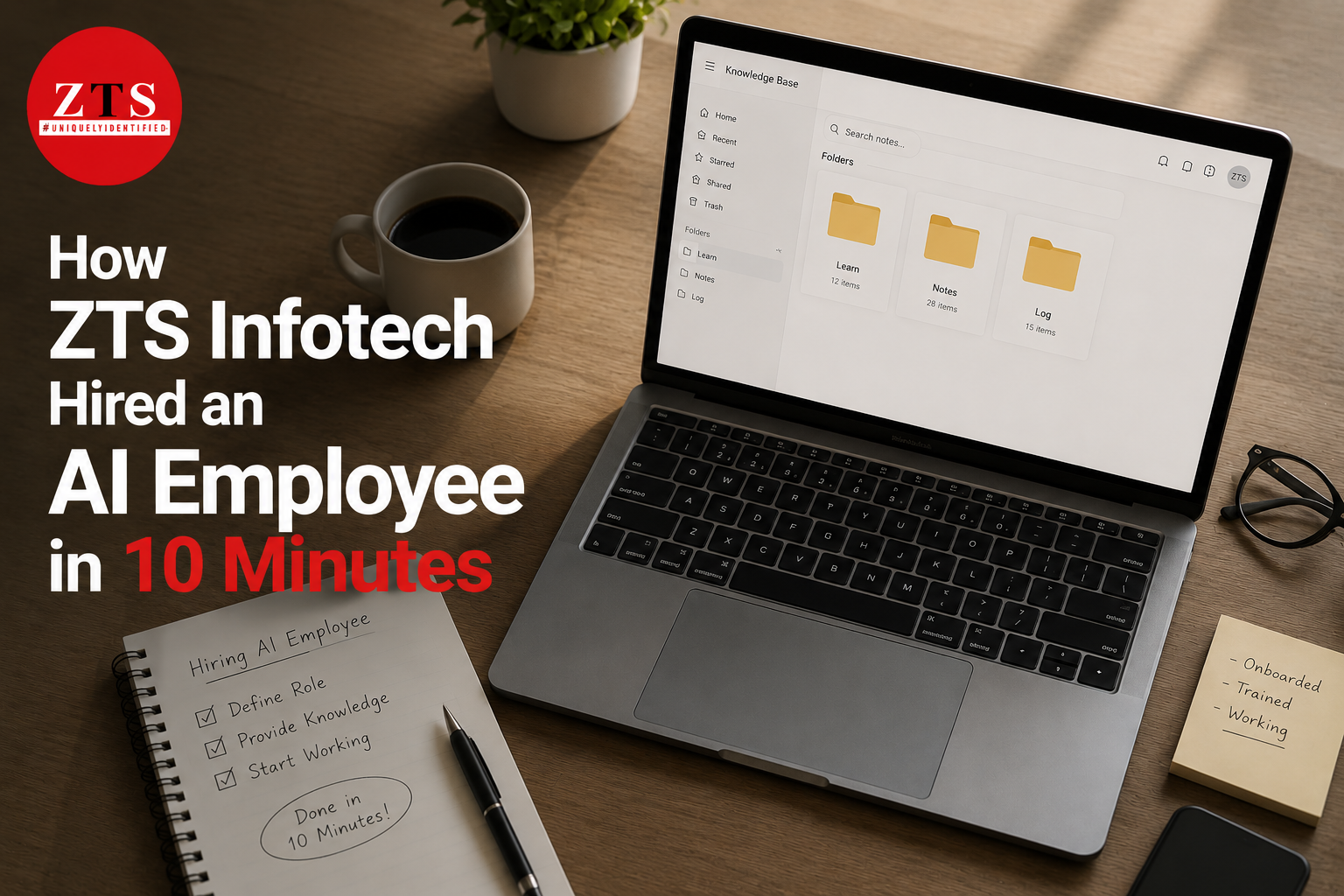
The demonstration matters less as a product showcase and more as a glimpse of how AI agents are being redeployed outside their original job description. Coding assistants were built to read and reason about codebases; Das's experiment treats a company's operating procedures the same way — as structured knowledge an agent can ingest, organize, and eventually reason about on its own.
Building Its Own Onboarding Structure
Das started with nothing more than an empty folder. A single prompt was enough for Claude Code to design its own onboarding framework inside it — one place to learn how the business runs, one place to keep absorbing new information, and one place to record what it figures out. He then handed it the company's actual process documentation and asked it to learn how the business operates. According to Das, the agent read every file and understood the workflows faster than any human hire he's brought on. The bottleneck in most onboarding isn't intelligence — it's that humans get tired, skim documents, and ask the same question twice. An agent that reads exhaustively and retains what it reads removes exactly that friction, at least for the parts of onboarding that are pure information transfer rather than judgment or relationship-building.
Turning New Information Into Institutional Memory
The more interesting layer is what happens after the initial read. Das connected the setup to Obsidian, a free note-taking app, using its Web Clipper browser extension: any article he finds relevant gets saved with one click, and a single instruction back in Claude Code folds it into the agent's own notebook — no re-explaining, no repeating himself. The system builds what Das calls a "second brain" for the business: a continuously updated store of external knowledge, cross-referenced against internal process documents.
Why This Is More Than a Personal Productivity Trick
The capability Das highlights as the real payoff isn't retention — it's the ability to interrogate the system. He can ask whether the company's current process still holds up, and the agent identifies specifically where practice has drifted from what's documented. That turns a static knowledge base into something closer to an ongoing internal audit, run on demand rather than during an annual review nobody has time for.
For business leaders, that's the detail worth paying attention to. Plenty of tools promise to organize company knowledge; far fewer actively flag when it's gone stale. Processes decay quietly — a workaround becomes the norm, a tool gets swapped, a policy gets bent for one client and never un-bent. An agent that compares stated process against accumulated context offers a way to catch that drift before it compounds.
Where Businesses Should Move Carefully
This approach isn't without real considerations. Feeding proprietary process documents into any AI system raises data-handling questions that deserve a clear answer before rollout — where that information is processed, stored, and who else can access it. The system also relies on a human curating what gets ingested, and its process-gap findings still need verification before anyone acts on them. Treat this as an assistive layer for institutional memory, not an unsupervised decision-maker.
The pattern generalizes well beyond one founder's desk. Any business with documented procedures — client playbooks, compliance checklists, vendor workflows — has the same raw material to work with. Franchise operations, agencies managing multiple accounts, and fast-growing teams that hire faster than they can train are natural candidates, since each faces the same problem: knowledge that lives in a few people's heads rather than in a system anyone can consult.
Expert Perspective
What's notable here isn't the novelty of the tools — Claude Code and Obsidian are both established, publicly available products — but the reframing of what an AI coding agent is for. Businesses have largely evaluated these tools on their ability to write or debug code; Das's setup treats the same reasoning ability as a general-purpose knowledge engine applied to operations rather than software. That's a meaningful signal for where AI adoption inside small and mid-sized businesses is heading next: less about replacing a single task, more about building a persistent, queryable memory of how the business actually works. The businesses that start structuring their process documentation now, rather
than waiting until an agent needs it handed over all at once, will likely be the ones that get ahead of this shift.
Key Takeaways
• ZTS Infotech demonstrated using Claude Code, an AI coding agent, to learn and organize a business's internal processes rather than write software.
• The agent built its own knowledge structure from an empty folder, then read the company's process documents directly.
• Obsidian's free Web Clipper extension feeds new articles into the agent's notes with one click, growing its knowledge base continuously.
• The standout capability: asking the agent whether current practice still matches documented process, surfacing where operations have drifted.
• The approach works best as an assistive layer for institutional memory, not an unsupervised decision-maker.
• Data-handling practices for proprietary documents fed into the system should be clarified before wider rollout.
• The pattern applies broadly to any business running on documented procedures, from agencies to franchise operations.
Conclusion
The value in Das's demonstration isn't the speed — it's the shift in what business leaders ask an AI agent to do. Instead of automating a single task, he built a system that absorbs, organizes, and questions the business's own operating knowledge continuously. As more companies experiment with agents like Claude Code beyond coding, the ones paying attention now to how they document their processes will be positioned to put that knowledge to work first.
-

Writen by Anirban Das
