 USA:
USA:  India:
 Every business leader has, by now, sat through a demo of an AI assistant that answers questions convincingly and then leaves the actual work undone. Andrew Ng, the Coursera co-founder and a fixture in enterprise AI circles through DeepLearning.AI, is betting that the next wave of adoption won't come from better answers — it will come from finished output. On July 23, 2026, Ng and Rohit Prasad released OpenWorker, a free, fully open-source desktop agent built on a simple premise: give it a goal, not a prompt, and it hands back a completed file.
For companies that have spent two years experimenting with AI copilots and chat interfaces, that is a shift worth watching. OpenWorker is not another wrapper around a single model provider, and it is not another subscription. According to its creators, it is not designed to talk — it is designed to deliver.
What OpenWorker Actually Does
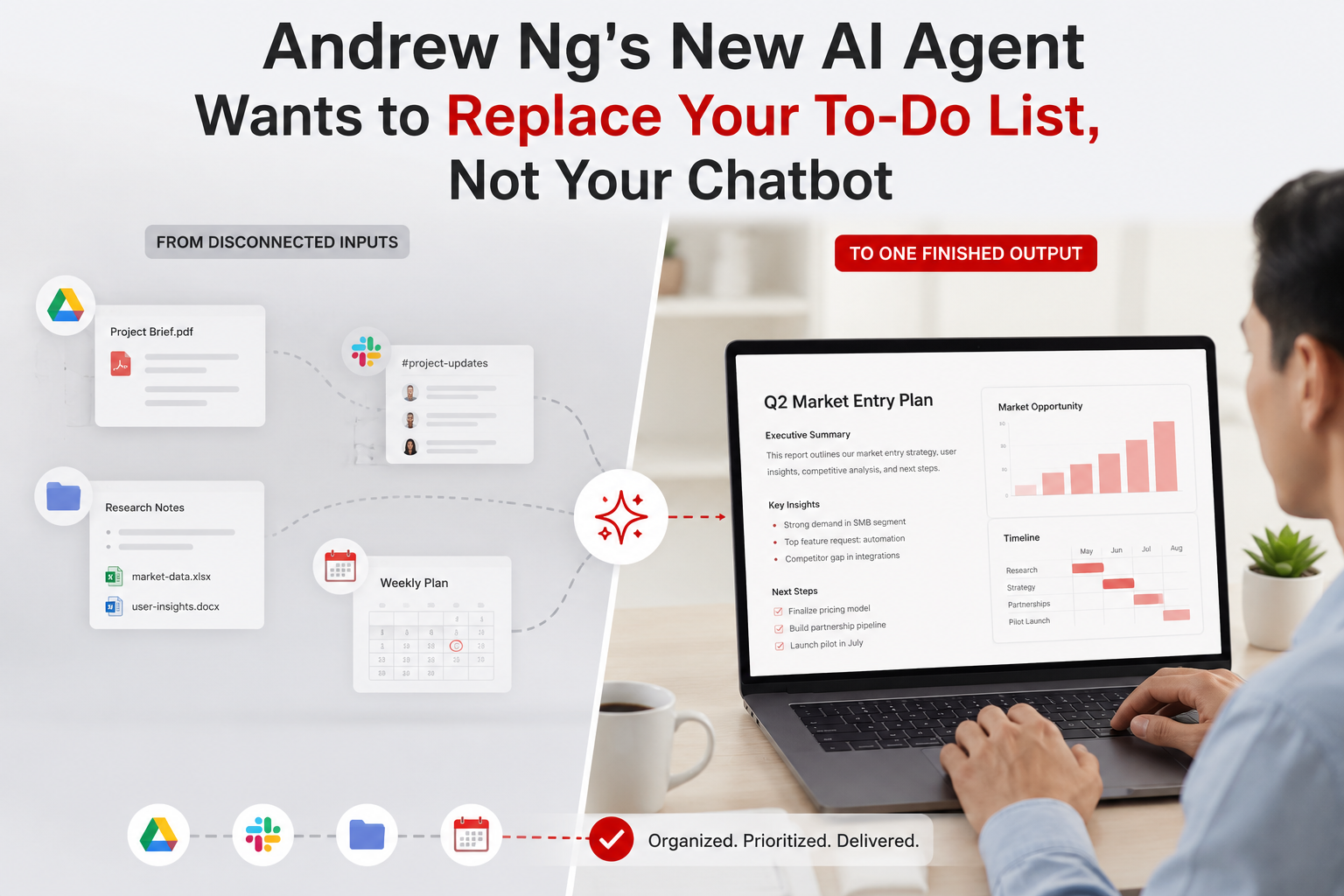
The tool works from a goal rather than a prompt. Point it at a task — "prepare a renewal brief for this client" or "triage my inbox" — and OpenWorker plans the steps, reads the relevant files, and works across the applications a business already relies on, including Slack, Notion, Jira, and Gmail. The result lands as a finished deliverable rather than a conversational reply.
In a hands-on test by the ZTS Infotech team, OpenWorker was given a folder of client notes, a contract summary, and a support ticket log, with instructions to produce a one-page renewal risk brief as an HTML file. The agent read every document, flagged risk factors on its own, and returned a clean, presentable brief without back-and-forth prompting — reportedly finishing the exercise in under four minutes.
Two Design Choices That Set It Apart
Two features distinguish OpenWorker from the broader field of AI agent tools now competing for enterprise attention.
It is model agnostic. Businesses can plug in an API key from OpenAI, Anthropic, Google's Gemini, DeepSeek, or Qwen — whichever provider they already have a relationship with — or run the tool entirely offline through Ollama at no cost. That flexibility matters for organizations wary of being locked into a single vendor's roadmap, pricing, or data policy.
It runs on a tiered permission system. Every action is classified by risk — reading a file sits in one tier, running a terminal command in another, sending an external message in a third — and the agent checks in with the user before anything consequential happens. MarkTechPost describes this as a local-first design, with execution happening on the user's own machine under explicit approval gates, a meaningful distinction for companies handling sensitive client or financial data.
OpenWorker is released under an MIT license, is available now for macOS, and Windows support is expected to follow.
Why This Matters for Business Leaders
Most AI tools marketed to enterprises fall into one of two categories: chat interfaces that need constant human steering, or narrow point solutions built for a single workflow. OpenWorker is positioning itself as something closer to a general-purpose operator, one that can be handed a business outcome and trusted to work toward it across the tools a team already uses.
That has direct implications for AI budgets and vendor risk. A free, open-source, model-agnostic agent removes two objections operations leaders raise most often about AI adoption: cost and lock-in. It also reframes the conversation from "which chatbot should we license" to "which workflows are worth automating end to end."
The permission tiering matters just as much from a governance standpoint. As boards and compliance teams grow more cautious about autonomous software touching client data, a system that visibly gates high-risk actions — rather than executing silently — gives IT and legal teams a framework they can actually evaluate.
Expert Perspective
The bigger story here is positioning, not feature count. Ng has spent years building tools aimed at making AI development accessible, and OpenWorker reads as that mission applied to knowledge work itself. By open-sourcing the agent and refusing to tie it to one model provider, the team is betting that value will accrue to whoever builds the best orchestration layer, not whoever controls the underlying model.
That is a break from the subscription-driven agent products crowding the market. For enterprise buyers, it lowers the cost of experimentation to nearly zero — a team can pilot OpenWorker against a real workflow, such as inbox triage or client reporting, without a procurement cycle. The permission system also anticipates the objection every CISO raises first: what happens when an autonomous agent touches something it shouldn't. Building that gate in from day one, rather than bolting it on after an incident, is what tends to separate tools built for real deployment from tools built for demos.
The near-term test will be reliability at scale — how OpenWorker handles messier business documents than a controlled demo folder, and how fast its connector library grows beyond the initial set. Early third-party coverage from MarkTechPost and StartupHub.ai has echoed the same conclusion: this is among the more credible attempts yet to move agents from answering questions to completing assignments.
Key Takeaways
- OpenWorker, released July 23, 2026 by Andrew Ng and Rohit Prasad, is a free, open-source, MIT-licensed desktop AI agent.
- It works from goals rather than prompts and returns finished files, not chat responses.
- The agent connects to workplace tools including Slack, Notion, Jira, and Gmail.
- It is model agnostic, supporting OpenAI, Anthropic, Gemini, DeepSeek, Qwen, or fully offline use via Ollama.
- A tiered permission system classifies every action by risk and requires user approval before consequential steps.
- Available now for macOS, with Windows support planned.
- A ZTS Infotech test produced a complete client renewal brief from raw files in under four minutes.
- The release lowers both the cost and vendor-lock-in barriers that have slowed enterprise AI agent adoption.
Conclusion:
OpenWorker won't be the last agent to promise finished work over conversation, but its mix of open-source licensing, model flexibility, and built-in governance gives it a stronger starting position than most.
For leaders evaluating where AI actually earns its keep, tools that turn raw files into completed deliverables — with guardrails compliance can point to — are worth watching as they move from early release to production use. Expect more clarity on Windows support, connector growth, and enterprise-scale performance in the months ahead.
-

Writen by Anirban Das
