 USA:
USA:  India:
Quick answer: On July 9, 2026, Google made AlphaEvolve — its Gemini-powered algorithm-optimization agent — generally available to every Google Cloud customer through the Gemini Enterprise Agent Platform. Instead of writing code from scratch, AlphaEvolve takes an existing algorithm, tests thousands of small mutations against a scoring function you define, and keeps only the versions that perform better. Early users, including FM Logistic, BASF, Coolblue, JetBrains, and Kinaxis, are already reporting measurable gains, and Google itself has used the system to redesign parts of its Tensor Processing Unit chips and recover compute capacity across its data centers.
For most of last year, AlphaEvolve was something you had to apply for. It sat behind a private preview and, later, an early-access program, tested quietly inside a handful of organizations working on logistics, chip design, genomics, and financial modeling. That changed this week. Google has opened the tool to any business running workloads on Google Cloud, marking one of the more unusual product launches of 2026 — not because it writes code, but because of how it writes it.
What AlphaEvolve Actually Does
Most people's mental model of AI coding tools is an assistant that autocompletes functions or answers questions about a codebase. AlphaEvolve works differently. It behaves less like an assistant and more like a search process.
Here's the basic loop, in plain terms:
- You provide a seed. This is your existing algorithm — the delivery-routing logic, the forecasting model, the chip circuit design — along with a clear definition of the problem it's meant to solve.
- You define success. AlphaEvolve needs a scoring function: a way to measure whether a new version of the algorithm is actually better than the last one, whether that's fewer miles driven, lower forecast error, or faster chip performance.
- The system proposes changes. Using Gemini models underneath — a faster model for breadth, a more capable one for depth — AlphaEvolve generates variations of the code and adds them to a growing pool of candidates.
- It tests, selects, and repeats. Each candidate gets scored. The best performers become the starting point for the next round of changes. This cycle can run hundreds of times without a human reviewing every step.
- You deploy the winner. The final output is human-readable code that a team can inspect, verify, and push into production — not a black box.
The result, in Google's own framing, is code that a human engineer likely wouldn't have arrived at on their own, simply because the search space of possible solutions is too large to explore by hand.
Why the Rollout Matters
AI tools that generate code are common now. Tools that evolve working code against a measurable goal, at scale, and hand back something production-ready are not. That distinction is why AlphaEvolve's move to general availability is getting attention beyond the usual developer-tool crowd.
It also matters because of where it's already been tested. This wasn't a launch based on lab benchmarks — it followed roughly seven months of real deployments during the private preview and early-access phases.
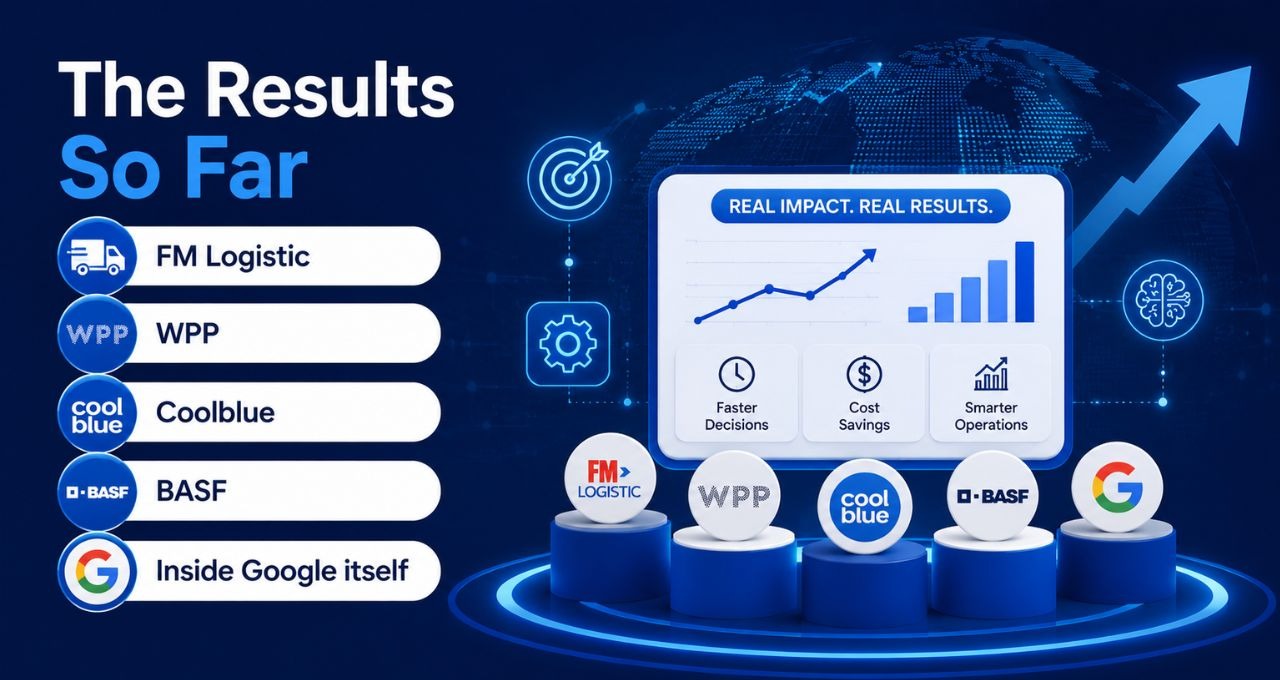
The Results So Far
A handful of numbers are doing most of the talking in Google's announcement and in early press coverage:
- FM Logistic reported a double-digit improvement in delivery and warehouse routing efficiency, even on networks that had already been through conventional optimization.
- WPP has pointed to meaningful gains in campaign prediction accuracy after applying AlphaEvolve to its forecasting workflows.
- Coolblue used the tool on its 28-day demand forecasting pipeline and, after roughly 200 iterations, reduced its forecast error by more than 5% — driven by better feature engineering and an improved ensemble of models.
- BASF used AlphaEvolve to build a supply-chain digital twin after earlier attempts using traditional deterministic models had failed outright.
- Inside Google itself, the system contributed to the design of more efficient arithmetic circuits now built into next-generation TPU silicon, and it has helped Google's data centers recover roughly 0.7% of global compute capacity on an ongoing basis — a small-sounding percentage that translates into a large amount of infrastructure at Google's scale.
None of these are one-time tweaks. Several of the companies describe AlphaEvolve as an ongoing part of their engineering process rather than a single optimization project.
How Your Data Is Handled
One detail worth calling out for any business considering this: AlphaEvolve's evaluation step runs on the customer's own infrastructure, not Google's. The scoring script that tests each candidate solution executes locally, and only the resulting performance score is passed back to the system. In other words, the proprietary algorithm, the underlying data, and the evaluation logic itself don't need to leave the customer's environment — Google's models never directly see the sensitive inputs, only how well a candidate scored.
For industries like pharmaceuticals, finance, and defense-adjacent manufacturing, where the algorithm itself can be as sensitive as the data it processes, that architecture is likely to matter as much as the performance gains.
What This Signals About the Direction of AI Tools
The broader story here isn't really about one product. It's about a shift from AI tools that help people write code faster to AI tools that search for better code than a person would think to write in the first place. That's a narrower use case than a general-purpose coding assistant, but it's aimed at a category of problem — large-scale optimization — where even small percentage gains translate into real money, real fuel savings, or real compute capacity.
At ZTS Infotech Pvt Ltd., we track AI tools that change what is possible — not just what is faster. AlphaEvolve's general availability fits squarely into that lens: it isn't shaving minutes off a coding task, it's finding solutions to optimization problems that were previously considered settled.
Our CEO, Anirban Das, has said the firm pays closest attention to AI systems that verify their own output before a human ever has to. "The tools that matter most right now aren't the ones that generate the most code," Mr. Das said. "They're the ones that can prove, with a measurable score, that what they generated is actually better than what existed before. That's the difference between a novelty and something a serious engineering team can put into production."
Frequently Asked Questions
1. What is AlphaEvolve and how is it different from a regular AI coding assistant?
AlphaEvolve is a Gemini-powered agent built by Google DeepMind that optimizes existing algorithms rather than generating new code from a blank page. It starts with a working "seed" algorithm, generates many mutated versions, tests each one against a scoring function you define, and keeps the best-performing results. Standard AI coding assistants typically autocomplete or suggest code based on context; AlphaEvolve runs an evolutionary search loop across hundreds of iterations to find solutions a human likely wouldn't write manually.
2. When did AlphaEvolve become generally available on Google Cloud?
Google announced general availability on July 9-10, 2026, making AlphaEvolve accessible to all Google Cloud customers through the Gemini Enterprise Agent Platform. It had previously been limited to a private preview launched in December 2025 and a subsequent early-access program.
3. Does AlphaEvolve require sharing sensitive company data with Google?
No. The evaluation step, where each candidate algorithm is scored, runs on the customer's own infrastructure. Only the resulting performance score is sent back to AlphaEvolve, meaning the underlying algorithm and data can stay within the customer's environment.
4. What kinds of companies are using AlphaEvolve, and what results have they seen?
Reported early adopters include FM Logistic, WPP, Coolblue, BASF, JetBrains, and Kinaxis, spanning logistics, advertising, e-commerce forecasting, and supply-chain planning. Reported outcomes include double-digit routing efficiency gains, improved campaign prediction accuracy, and demand-forecast error reductions of more than 5%. Internally, Google has used AlphaEvolve to help design more efficient TPU circuits and to recover roughly 0.7% of its global data center compute capacity.
The Bottom Line:
AlphaEvolve's move from private preview to full general availability marks a real inflection point for how AI is used in engineering-heavy industries. It won't replace the work of defining problems clearly or judging which trade-offs matter for a business — that responsibility still sits with human teams.
But for the narrower job of searching an enormous space of possible algorithms and returning ones that measurably outperform the original, it's now something any Google Cloud customer can try, not just a handful of early partners.
Need more update? Subscribe to us and click here for more details.
-

Writen by Anirban Das
