 USA:
USA:  India: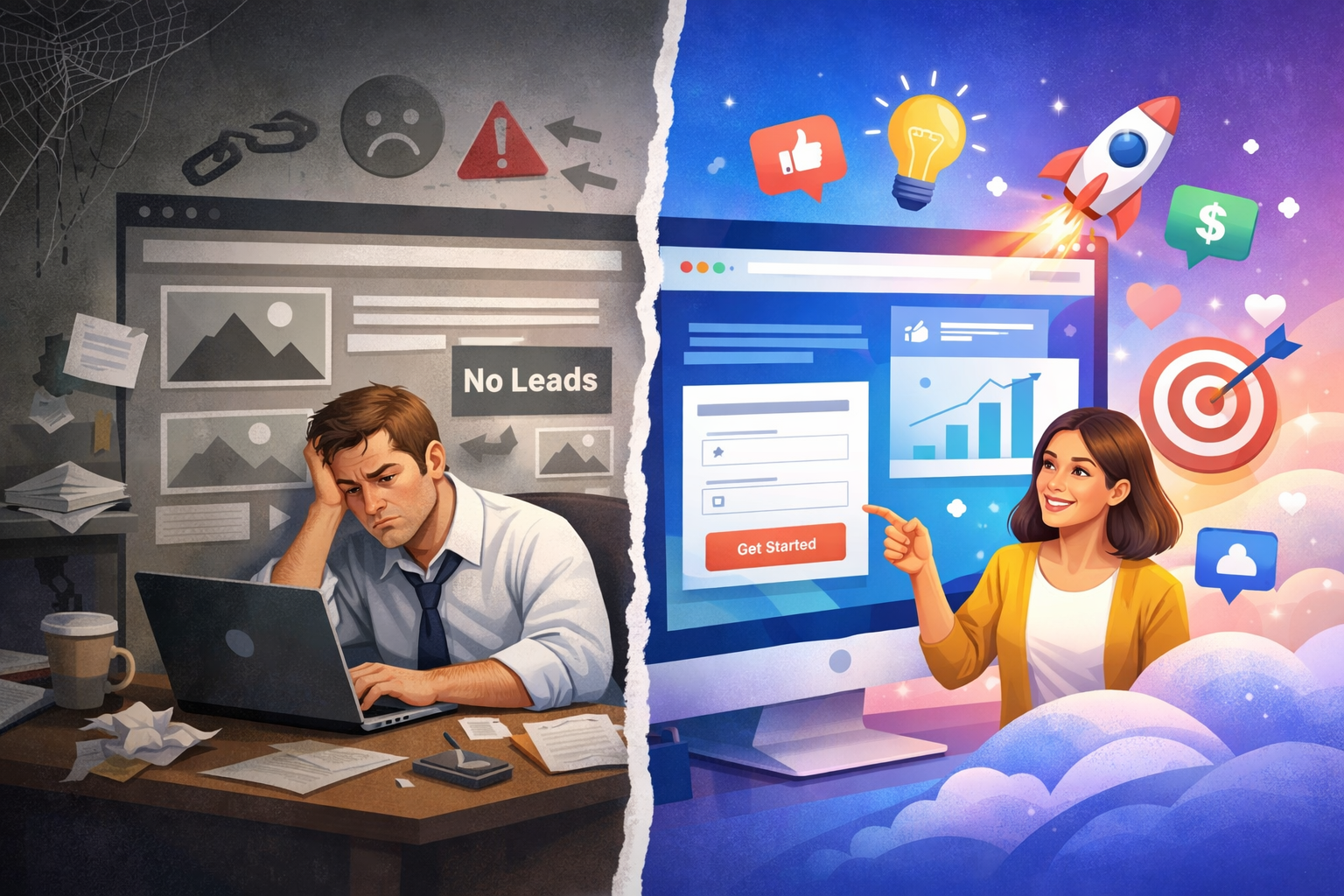
You've invested in a website. You're driving traffic to it. Yet somehow, the leads just aren't coming through. Sound familiar?
Here's the uncomfortable truth: your website might actually be working against you. Not because it's ugly or outdated (though that doesn't help), but because it's fundamentally failing to do what websites are supposed to do in this year, connect with people and convert them into customers.
I've spent over fifteen years watching businesses pour money into websites that look good on paper but perform terribly in practice. The problem isn't usually a lack of effort. It's a misunderstanding of what makes modern websites actually work.
Let me show you what's probably going wrong with yours, and more importantly, how to fix it.
The Real Reason Your Website Isn't Converting
Before we dive into solutions, let's diagnose the problem. Most business owners think their website isn't generating leads because they need more traffic. Wrong. Traffic without conversion is just noise.
Your website is likely suffering from one or more of these critical issues:
It takes too long to load. When was the last time you waited more than three seconds for a page to load? Exactly. Neither do your potential customers. Studies show that 53% of mobile users abandon sites that take longer than three seconds to load. Every extra second of load time can decrease conversions by up to 7%. If your website is sluggish, you're literally watching money disappear while a progress bar spins.
The user experience is confusing. Your visitors shouldn't need a roadmap to figure out what you do or how to contact you. If someone lands on your homepage and can't immediately understand your value proposition, you've already lost them. Confusion is the conversion killer. When users can't find what they're looking for within seconds, they bounce, and they don't come back.
It doesn't work properly on mobile devices. Over 60% of web traffic now comes from mobile devices. If your site looks broken on a smartphone or requires users to pinch and zoom to read text, you're essentially telling the majority of your audience to go somewhere else. Mobile optimization isn't optional anymore. It's the baseline expectation.
There's no clear path to action. What do you want visitors to do? Sign up? Call you? Request a quote? If the answer isn't crystal clear and incredibly easy to execute, people won't do it. Every page needs a purpose and a clear next step.
It looks and feels generic. Your website should reflect your brand's personality and values. Generic templates that look like everyone else's don't build trust or differentiate you from competitors. People do business with companies they feel connected to, and that connection starts with authentic design.
How Modern Design Actually Solves These Problems
Modern web design isn't about following trends for the sake of aesthetics. It's about creating experiences that guide users naturally toward becoming customers. Here's how contemporary design approaches address each of those conversion killers.
Speed That Matches Expectations
Modern websites are built with performance as a primary concern, not an afterthought. This means optimizing images, minimizing code, leveraging browser caching, and using content delivery networks to serve pages faster regardless of where users are located.
But here's where it gets interesting. At ZTS Infotech, we've found that combining AI tools with human expertise creates websites that load remarkably fast without sacrificing quality. AI can automatically optimize images, suggest code improvements, and identify performance bottlenecks that even experienced developers might miss. Meanwhile, our human developers make strategic architectural decisions that AI alone couldn't make.
This collaborative approach between artificial intelligence and human intelligence, what we call the AI + HI model, means you get websites that are both technically superior and strategically sound. The AI handles the repetitive optimization tasks at scale, while our team focuses on the creative problem-solving that actually moves the needle for your business.
Intuitive Navigation That Guides Action
Good navigation is invisible. Users shouldn't have to think about how to find information. They should just find it.
Modern design uses clear hierarchies, logical grouping, and strategic placement of calls-to-action to create pathways that feel natural. Your most important information should be accessible within two clicks from anywhere on your site. Your contact information should be visible on every page.
Think of your website like a conversation with a customer. Would you ramble for ten minutes before getting to the point? Would you hide your phone number and make people search for how to reach you? Of course not. Yet that's exactly what poorly designed websites do.
Mobile-First Thinking
Designing for mobile first isn't just about making things smaller. It's about rethinking the entire user experience for touch interfaces, smaller screens, and on-the-go browsing behavior.
Modern mobile design considers thumb zones (the areas of the screen easily reached with one hand), loading priorities (what users see first while the rest loads), and simplified interactions that work without a mouse. When we design mobile experiences, we start by asking what a user urgently needs in that moment and deliver exactly that.
Strategic Calls-to-Action
Every element on your page should guide users toward a specific action. Modern design uses visual hierarchy, color psychology, and strategic placement to make these calls-to-action impossible to miss yet never pushy.
The key is understanding user intent at different stages. Someone landing on a blog post might not be ready to buy, but they might subscribe to a newsletter. Someone on a pricing page is much further along and needs a clear path to get started immediately. Modern websites accommodate these different mindsets with appropriate CTAs throughout the journey.
Authentic Brand Expression
This is where human creativity becomes irreplaceable. While AI can analyze successful design patterns and suggest layouts, it takes human designers to truly capture what makes your business unique.
Your website should tell your story in a way that resonates with your ideal customers. The colors, typography, imagery, and tone should all work together to create an experience that feels distinctly yours. Generic doesn't cut it anymore because consumers are sophisticated. They can spot template design instantly, and it makes you look like you don't care enough to invest in your own brand.
The Technical Foundation That Makes It All Work
Beautiful design means nothing if the underlying technology is shaky. Modern websites need solid technical foundations:
Clean, semantic code that search engines can easily crawl and understand. Proper security protocols that protect user data and build trust. Scalable architecture that grows with your business. Analytics integration that shows you exactly how users interact with your site.
This is another area where the combination of AI assistance and human expertise creates superior results. AI can help identify security vulnerabilities, suggest SEO improvements, and even write certain types of code faster than humans. But human developers provide the strategic thinking, quality control, and creative problem-solving that AI can't replicate.
When you work with a mobile app and website design and development services company that leverages this collaborative approach, you get the best of both worlds: the efficiency and pattern recognition of AI combined with the creativity and strategic thinking of experienced professionals.
Imagine if your website worked as hard as your best salesperson. What if it answered questions, built trust, and guided prospects toward working with you—all automatically, 24 hours a day?
That's what modern web design delivers. Not just a digital brochure, but an active lead generation machine that represents your business exactly the way you'd want, every single time someone visits.
Making the Change Without Starting Over
Good news: fixing your website doesn't necessarily mean rebuilding from scratch. Sometimes strategic updates to specific areas can dramatically improve performance.
Start with an honest audit. Use tools like Google PageSpeed Insights to check your load times. Look at your analytics to see where people are dropping off. Test your site on different devices. Ask friends or colleagues for their honest first impressions.
Then prioritize fixes based on impact. If your mobile experience is terrible, start there. If your homepage doesn't clearly communicate what you do, rewrite it. If your contact forms are buried, make them prominent.
The most successful website improvements I've seen over my career have come from businesses that approach their site as an evolving asset rather than a one-time project. Your market changes. Your offerings change. Your website should change with them.
The Bottom Line
Your website should be your hardest-working employee. If it's not generating leads, it's not because lead generation is hard, it's because something specific is broken in the user experience, the technical performance, or the strategic positioning.
Modern design fixes these problems by combining fast performance, intuitive navigation, mobile optimisation, clear calls-to-action, and authentic brand expression. And when you add AI-assisted development to experienced human creativity and strategy, you accelerate results while maintaining the quality and uniqueness that make your business stand out.
Stop accepting a website that just exists. Demand one that performs. Your business deserves digital representation that actually converts visitors into customers, and modern design makes that possible.
The question isn't whether you can afford to fix your website. It's whether you can afford not to.
-

Writen by Anirban Das
