 USA:
USA:  India:
 .png)
Introduction: Something Has Quietly Shifted
Picture two UK retailers — both selling similar products, operating in the same niche, even spending similar amounts on paid ads.
Six months later, one of them has seen a 34% increase in conversion rate, a significant drop in cart abandonment, and their average order value is climbing steadily. The other? Still guessing which products to promote, still sending the same email newsletter to every customer, still wondering why their bounce rate refuses to budge.
The difference isn't budget. It isn't brand recognition. It's the technology sitting underneath their ecommerce website.
AI ecommerce website development UK has moved from being a buzzword in conference presentations to a genuine commercial differentiator — and in 2026, that gap between businesses using it and those ignoring it is no longer small. It's a chasm.
This isn't a post about hype. It's about what's actually happening on the ground, why retailers across the UK are making the switch right now, and what you risk by holding off any longer.
The Current State of UK Retail Ecommerce in 2026
Let's be honest about where we are.
The UK ecommerce market has matured — and with maturity comes brutal competition. According to recent industry data, UK consumers are more digitally savvy than ever. They expect frictionless experiences, relevant recommendations, and lightning-fast load times. More importantly, they're loyal to experiences, not brands.
Post-pandemic habits have cemented online shopping as the default for millions of households. But that surge in online demand has been matched by a surge in online sellers. The barrier to entry has never been lower — which means standing out has never been harder.
Traditional ecommerce platforms — even well-built ones — are running into the same core problem: they're reactive. They show customers what's already happened, not what's about to happen. They don't adapt. They don't predict. They serve the same experience to a 22-year-old in Manchester and a 55-year-old in Edinburgh.
That model is creaking. And UK retailers — particularly those in the SME space who can't afford to be complacent — are starting to feel it.
What's Changed in 2026 Specifically?
A few things have converged to make this the tipping point year:
- AI tooling has matured. It's no longer experimental. The models are stable, the integrations are proven, and the costs have come down dramatically.
- Consumer expectations have spiked. After years of Amazon-level personalisation, shoppers now experience "generic" websites as actively off-putting.
- Privacy-first marketing has forced a rethink. With third-party cookies largely gone, first-party data — intelligently used — is the only sustainable engine for growth.
- Operational costs are rising. Energy, staffing, fulfilment — retailers are looking at every corner for efficiency. AI delivers it.
The conditions are right. The tools are ready. The only question is whether you move now or after your competitors do.
What "AI-Powered Ecommerce" Actually Means (Without the Jargon)
Before we go further, let's clear something up — because there's a lot of noise around this.
An AI-powered ecommerce website isn't just a Shopify store with a chatbot bolted on. It's also not some futuristic concept that requires a team of data scientists to operate.
At its core, AI ecommerce means your website uses intelligent systems to:
- Learn from user behaviour — continuously, not just through periodic reports
- Make real-time decisions — about what to show, when to show it, and to whom
- Automate repetitive processes — from email sequences to inventory alerts
- Optimise for outcomes — not just traffic, but actual revenue
Think of it as the difference between a static shop window that never changes, and a brilliant shop assistant who remembers every customer, knows their preferences, and always suggests exactly the right thing at the right moment.
That's not science fiction. That's what well-executed AI web development for e-commerce UK delivers in 2026.
The Real Reasons UK Retailers Are Switching to AI Ecommerce
1. Personalisation at Scale — The Thing Every Retailer Wants But Can't Manually Achieve
Every retailer knows personalisation works. The problem has always been doing it at scale.
You can personalise for 50 customers. You cannot personalise for 50,000 — not without AI.
Modern AI ecommerce systems analyse dozens of signals simultaneously: browsing history, purchase patterns, time of visit, device type, location, even the way someone scrolls through a product page. From all of that, they build a dynamic experience unique to each visitor.
The result? Product recommendations that feel eerily relevant. Homepage banners that speak to what that specific customer actually cares about. Email subject lines that change based on predicted behaviour.
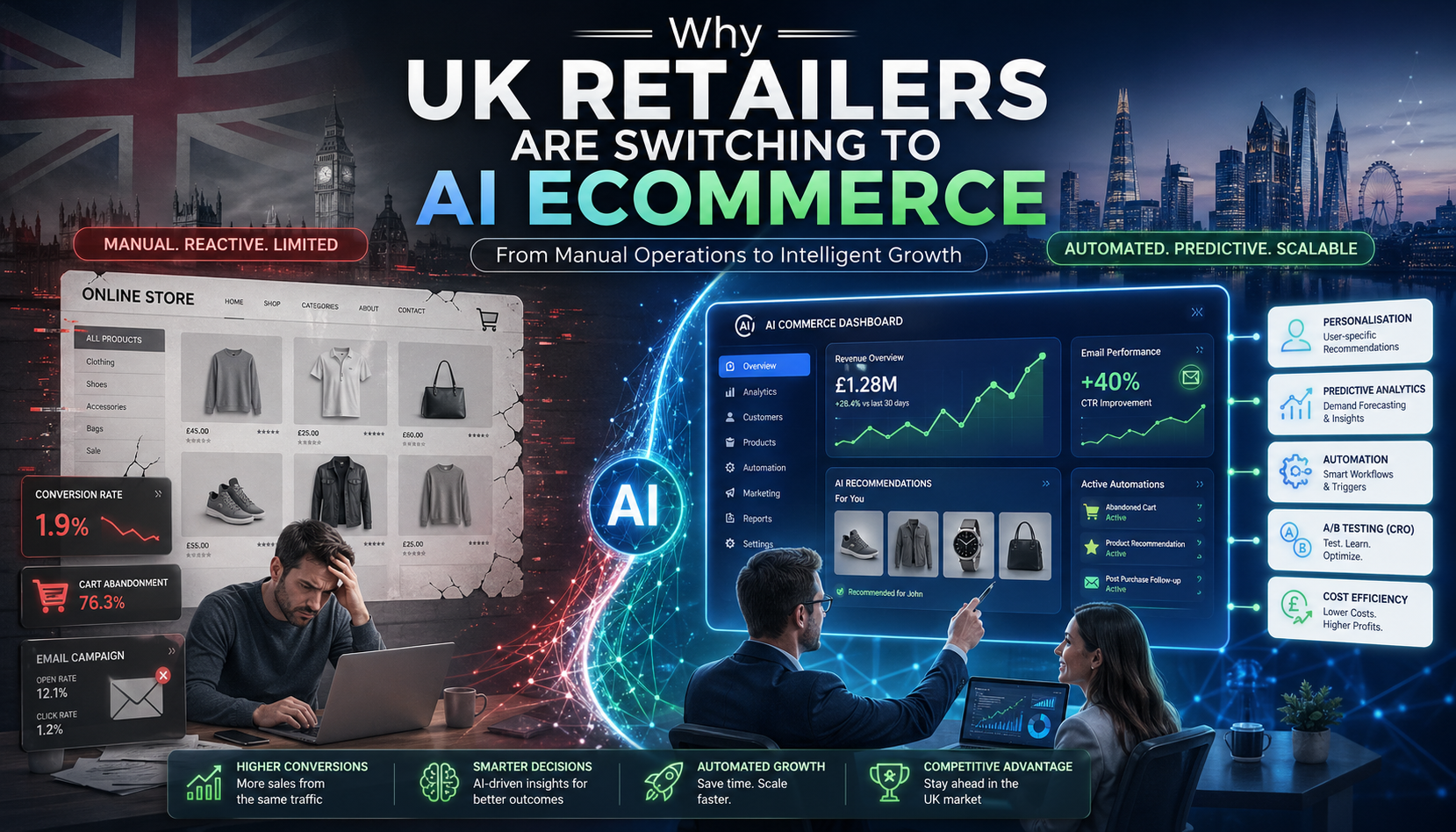
A UK fashion retailer we're aware of implemented AI-driven personalisation and saw their email click-through rates increase by over 40% within two months — simply because the content was relevant instead of generic.
That's not a marginal gain. That's a transformation.
2. Predictive Analytics That Actually Drive Smarter Decisions
Most ecommerce businesses are drowning in data and starving for insight.
Your analytics dashboard tells you what happened last month. AI tells you what's likely to happen next week — and what you should do about it.
Predictive analytics in an AI ecommerce context means:
- Demand forecasting — knowing which products will spike before they spike, so you're never caught over or understocked
- Churn prediction — identifying customers who are about to disengage, so you can intervene with the right offer at the right time
- Pricing intelligence — dynamically adjusting prices based on competitor data, demand signals, and margin targets
For a UK retailer managing thousands of SKUs across multiple categories, this kind of intelligence isn't a luxury. It's a competitive necessity.
3. Automated Customer Journeys That Don't Sleep
Here's something worth sitting with: your best competitor's AI system is working at 3am on a Tuesday, nurturing a lead, recovering an abandoned basket, and sending a perfectly timed re-engagement email.
Meanwhile, your current setup is waiting for someone to log in on Monday morning and check the reports.
AI ecommerce platforms automate entire customer journey sequences based on real-time triggers. Someone abandons their cart? The system responds within minutes — not with a generic "you left something behind" email, but with a message tailored to what they were looking at, perhaps bundled with a relevant offer.
A customer makes their third purchase? The system recognises loyalty and automatically initiates a VIP sequence.
This level of automation, done well, feels human. That's the goal — and it's what separates genuinely intelligent systems from basic rule-based workflows.
4. Conversion Rate Optimisation That Never Stops Testing
Traditional CRO is expensive and slow. You hypothesise, you test, you wait six weeks for statistical significance, and then you apply the winning variant — which may already be outdated.
AI-powered CRO works continuously and at a scale no human team can match.
These systems run multivariate tests across product pages, checkout flows, navigation structures, and CTAs — simultaneously, across different audience segments — and apply winning combinations in near real-time.
They also consider context. The highest-converting product page layout for a first-time mobile visitor at 7pm on a Friday is not the same as for a returning desktop user on a Wednesday afternoon. AI knows that. Traditional A/B testing doesn't.
For UK retailers where even a 1% improvement in conversion rate can mean tens of thousands of additional revenue per year, this is where the ROI of AI ecommerce optimization services becomes very concrete, very quickly.
5. Cost Efficiency That Makes the Business Case Obvious
Here's the argument that often seals the deal for UK SME owners who are cautious about new tech investment.
Yes, there's an upfront cost to building an AI-powered ecommerce website properly. But compare it to the ongoing cost of:
- Manual customer service staff handling queries that a smart AI assistant could resolve instantly
- Marketing teams manually segmenting audiences and building campaigns by hand
- Developers being called in to make small site updates that an intelligent system could automate
- Lost revenue from poor product recommendations and untargeted promotions
When you lay it out, the ROI case for AI ecommerce isn't about spending more — it's about spending smarter and recouping far more in return.
A Realistic Scenario: A UK Home & Lifestyle Brand Gets It Right
Let's make this tangible.
Imagine a UK-based home and lifestyle retailer — around £3m annual online revenue, a team of 15, selling across their own site and two marketplaces.
Before AI: They were sending a weekly newsletter to their entire list, running manual Google Shopping campaigns, and relying on gut instinct for stock buying decisions. Their site conversion rate hovered at 1.8%.
After partnering with an AI ecommerce development company UK to rebuild their platform with intelligent layers:
- Their homepage dynamically adapts to each visitor segment (new vs returning, browsing vs ready-to-buy)
- Product recommendations are generated in real-time based on session behaviour
- Their abandoned cart sequence is fully automated and personalised
- Inventory is now guided by predictive demand models
- Their customer service chatbot handles 60% of queries without human involvement
Within nine months: conversion rate up to 2.9%, average order value increased by 18%, and their customer service team — now freed from repetitive queries — is focused on genuinely complex customer relationships.
This isn't a fairytale. It's a repeatable outcome when AI ecommerce is implemented thoughtfully.
The Risk of NOT Adopting AI Ecommerce (This Section Matters)
Let's be direct here, because this is something many retailers underestimate.
The risk of NOT moving is no longer "you'll miss out on some extra revenue." The risk in 2026 is existential for some businesses.
Here's why:
Your competitors are not waiting. The larger players — and increasingly, smart SMEs — are already operating AI-driven platforms. Every month you delay is a month they're accumulating more data, refining their models, and widening the personalisation gap between their experience and yours.
Customer tolerance for generic experiences is running out. Consumers who experience a brilliant, relevant, fast ecommerce experience somewhere else will find your static, one-size-fits-all site jarring. They'll leave. They won't always know why. But AI-driven competitors will know exactly how to keep them.
First-party data advantage compounds over time. AI ecommerce systems get smarter the longer they run — because they learn from your specific customers. Starting later means starting from zero while your competitors are already on version three of their trained models.
Operational costs don't wait. If you're still running manual processes that AI could automate, those costs are silently eroding your margins every single month.
The window to move is still open. But it won't be indefinitely.
How to Get Started with AI Ecommerce: Practical Steps
If you're a UK retailer reading this and thinking "right, but where do I actually start?" — here's a sensible, grounded approach.
Step 1: Audit your current setup honestly.
What's your current conversion rate? Where are customers dropping off? What data are you actually collecting and using? You need a clear picture of the baseline before you can measure improvement.
Step 2: Identify your highest-impact opportunity.
Not every retailer needs to overhaul everything at once. For some, the biggest win is AI-powered personalisation. For others, it's predictive inventory. Start where the ROI is clearest for your specific business model.
Step 3: Choose the right platform and partner.
This is critical. There are plenty of plug-and-play AI tools, but truly effective AI ecommerce often requires a development partner who understands both the technical architecture and the commercial goals of UK retail.
You're not just buying software — you're building a system that will need to evolve with your business.
Step 4: Commit to the data layer.
AI is only as good as the data it learns from. Make sure your first-party data collection is clean, compliant with UK GDPR, and structured in a way that AI systems can actually use.
Step 5: Plan for iteration, not perfection.
Your AI ecommerce platform won't be "finished" on day one. It'll learn, improve, and expand over time. Set realistic expectations, measure the right metrics, and build in regular review cycles.
Working with the Right AI Ecommerce Development Partner
This is where it's worth being honest about the market.
Not every agency or development firm offering "AI ecommerce" services actually understands what that means at a technical and strategic level. Some are wrapping existing Shopify themes in AI language and calling it a day. That's not what we're talking about here.
What you want is a development partner with genuine expertise in AI web development for e-commerce — one who can architect intelligent systems that integrate meaningfully with your existing operations, not just overlay a few automated features on top of a conventional build.
ZTS India has been working with UK retailers and ecommerce businesses on exactly this kind of deep-integration AI development. Their approach combines technical architecture with commercial thinking — building systems designed around your revenue goals, not just your website requirements.
If you're at the stage of evaluating options, their AI ecommerce website development UK service page is worth a proper read. It outlines what a well-engineered AI ecommerce platform actually looks like in practice.
For retailers ready to move beyond surface-level AI features and build something genuinely intelligent, having a conversation with a team that has done this specifically in the UK market context is a good first step.
Conclusion: The Retailers Who Thrive in 2027 Are Making Decisions Now
AI ecommerce isn't coming. It's here, it's working, and UK retailers who've adopted it properly are pulling ahead — quietly, consistently, measurably.
The conversation has moved on from "should we explore AI?" to "how quickly can we implement it and how do we do it well?"
What's encouraging is that this isn't reserved for the Amazons and ASOSs of the world anymore. SME retailers with a clear strategy and the right development partner can deploy genuinely sophisticated AI ecommerce capabilities and compete at a level that simply wasn't possible three years ago.
The playing field has shifted. That's actually good news — if you move.
The retailers who will look back at 2026 as the year everything changed won't be the ones who waited to see how it all played out. They'll be the ones who decided to shape how it played out for their own business.
Ready to See What AI Could Do for Your Ecommerce Business?
If this has prompted questions about what an AI-powered rebuild or upgrade could look like for your specific setup, the best next step is a no-pressure conversation.
ZTS India offers UK retailers a consultative approach to AI ecommerce development — starting with understanding your commercial goals before touching a line of code.
Explore AI ecommerce development services built for UK retailers →
No jargon. No hard sell. Just a clear-eyed look at what's possible and what makes sense for your business right now.
Frequently Asked Questions
Q1. Is AI ecommerce only for large retailers with big budgets?
No. AI tooling costs have dropped considerably in 2026, and modular implementation means UK SMEs can start with one high-impact area — personalisation or predictive inventory — and scale from there.
Q2. How is this different from adding a chatbot or plugin?
A chatbot is a single feature. An AI ecommerce platform operates across the entire customer journey — homepage rendering, inventory, email timing, and checkout optimisation — all working together as one intelligent system.
Q3. How soon will we see results?
Most retailers notice early gains within 60–90 days. Meaningful shifts in conversion rate and average order value typically emerge between months four and nine, especially when first-party data is clean from day one.
Q4. Is it UK GDPR compliant?
Yes — when built correctly. AI ecommerce actually thrives in a post-cookie world because it runs on consented first-party data. Any credible UK development partner will build compliance into the architecture from the start.
Q5. Do we need to rebuild our entire site?
Not always. Personalisation engines and automated journeys can often layer onto existing platforms like Shopify or WooCommerce. A full rebuild only makes sense when the current architecture limits what the AI can actually do.
Q6. What's the most common mistake retailers make here?
Treating it as a software purchase rather than a business strategy. AI systems need to be anchored to specific commercial goals — reducing abandonment, improving repeat purchases — otherwise even good technology delivers disappointing results.
Final Thoughts
The businesses that will define the next chapter of UK retail ecommerce are not necessarily the biggest or the best-funded — they're the ones that are thinking clearly about how they compete, not just what they sell.
AI ecommerce represents a genuine structural shift in how online retail operates. Not a trend. Not an upgrade. A different way of doing business — one where your website learns, your marketing adapts, and your operations get sharper with every passing week.
What's striking about this moment in 2026 is that the technology has caught up with the ambition. The tools that were considered enterprise-only two years ago are now within reach for a well-run UK SME with the right development partner and a clear commercial strategy.
But here's what rarely gets said plainly enough: the window is open, not permanent.
Every month that an AI-driven competitor accumulates customer behaviour data, refines their personalisation models, and automates another layer of their operations — that's a month of compounding advantage they're building over businesses still running static, reactive sites.
The question UK retailers should be sitting with right now isn't "is AI ecommerce worth exploring?" — the answer to that is already settled. The real question is: "what specifically should we tackle first, and who do we trust to help us build it properly?"
Start there. The rest follows.
-

Writen by Anirban Das
