 USA:
USA:  India:
 Quick answer: Grok 4.5, released by SpaceXAI on July 8, 2026, is priced at $2 per million input tokens and $6 per million output tokens — roughly 75% more affordable than Anthropic's Claude Opus 4.8, which costs $5 and $25, respectively.
It ranks fourth on Artificial Analysis's Intelligence Index, behind Claude Fable 5, GPT-5.5, and Opus 4.8, but claims 4.2x better token efficiency on coding tasks, making its real-world cost per completed task dramatically lower than its rivals.
What Grok 4.5 actually costs
SpaceXAI, the company formed after xAI's merger into SpaceX, launched Grok 4.5 this week with a pricing structure built to make cost, not raw intelligence, the headline. The model runs at $2 per million input tokens, $0.50 per million cached input tokens, and $6 per million output tokens. For comparison, OpenAI's cheaper Luna tier sits around $1 input and $6 output, putting it roughly in line with Grok on the output side, while Anthropic's Opus 4.8 remains the most expensive of the three at $5 input and $25 output.
Elon Musk framed the release bluntly on X, describing Grok 4.5 as an Opus-class model that runs faster, burns fewer tokens, and costs less. That's a notable admission on its own — Musk isn't claiming Grok 4.5 beats Anthropic's current frontier model, Fable 5. He's comparing it to a prior generation of Claude and betting that most buyers care more about the bill than the benchmark.
How the benchmarks actually shake out
The performance picture is more mixed than SpaceXAI's marketing suggests, and that nuance matters for anyone deciding whether to switch.
Artificial Analysis, the independent benchmarking firm most enterprise buyers cite, places Grok 4.5 fourth on its Intelligence Index — behind Fable 5, GPT-5.5, and Opus 4.8, but ahead of every open-weight model and Google's Gemini lineup. On Terminal Bench 2.1, a test of complex command-line reasoning, Grok 4.5 scored 83.3%, essentially tied with GPT-5.5's 83.4% and trailing Fable 5's 84.3% by a single point.
Where Grok 4.5 pulls ahead is efficiency, not raw score. SpaceXAI says the model needs an average of 15,954 output tokens to resolve a task on SWE-Bench Pro, compared to 67,020 for Opus 4.8 running at max settings — a 4.2x gap. Because output tokens are the expensive side of the pricing ledger, that efficiency compounds with the lower per-token rate. Artificial Analysis measured the real-world result: about $0.49 per completed task on its GDPval-AA v2 index, which the firm called nearly 90% cheaper than the models ranked above it. On coding specifically, independent testing put Grok 4.5 at roughly $2.49 per task in Grok Build, versus $5.07 for GPT-5.5 in Codex and $11.80 for Fable 5 in Claude Code.
There's a catch worth flagging before anyone migrates a production pipeline. Artificial Analysis also found that while Grok 4.5's accuracy on its Omniscience Index rose from 35% to 52% over the prior generation, its hallucination rate more than doubled, jumping from 25% to 54%. In plain terms: the model knows more, but it's also more likely to sound confident while being wrong — a meaningful risk for any workflow that isn't closely supervised.
The Cursor deal changes the shape of the story
The pricing headline is only half of what's happening. Grok 4.5 was trained jointly with Cursor, the code editor SpaceX acquired in mid-June 2026 for roughly $60 billion in stock. Cursor's engineering team fed real developer interaction data — how programmers write, review, and debug, directly into the training process, and the model now ships inside Cursor across all plans, alongside the SpaceXAI console and the Grok Build agent.
That gives SpaceXAI something neither Anthropic nor OpenAI currently owns outright: a single stack that spans training compute (via Colossus), a frontier-adjacent model, and a widely used distribution channel in Cursor's developer base. Cursor has historically let developers choose between Claude, GPT, and other models inside the editor, so the practical question is whether that neutrality holds now that its parent company has its own model to promote.
Why this matters for enterprise buyers
Agentic workloads — where a model works autonomously for minutes or hours, reading a codebase, calling tools, and iterating on its own output — consume tokens far faster than a single chat exchange. That's exactly where token efficiency and per-token pricing compound into a real budget line item rather than a rounding error. A team running agents across a large engineering org will feel a 75% output-price gap much faster than a single developer running the occasional prompt.
The counterargument, and it's a real one, is that coding quality compounds too. A cheaper model that needs two or three attempts to fix a bug correctly can end up costing more in wasted developer time than a pricier model that gets it right the first time. Analysts covering the launch have repeatedly cautioned that benchmark scores and per-token pricing don't capture "cost per successful outcome" — a number that only shows up after weeks of real production use, not on launch day.
Grok 4.5 is expected to reach EU customers in mid-July 2026. Until broader adoption data comes in, the honest read is that SpaceXAI has built a credible, aggressively priced alternative — not a wholesale replacement for frontier-tier work that demands the highest possible reliability.
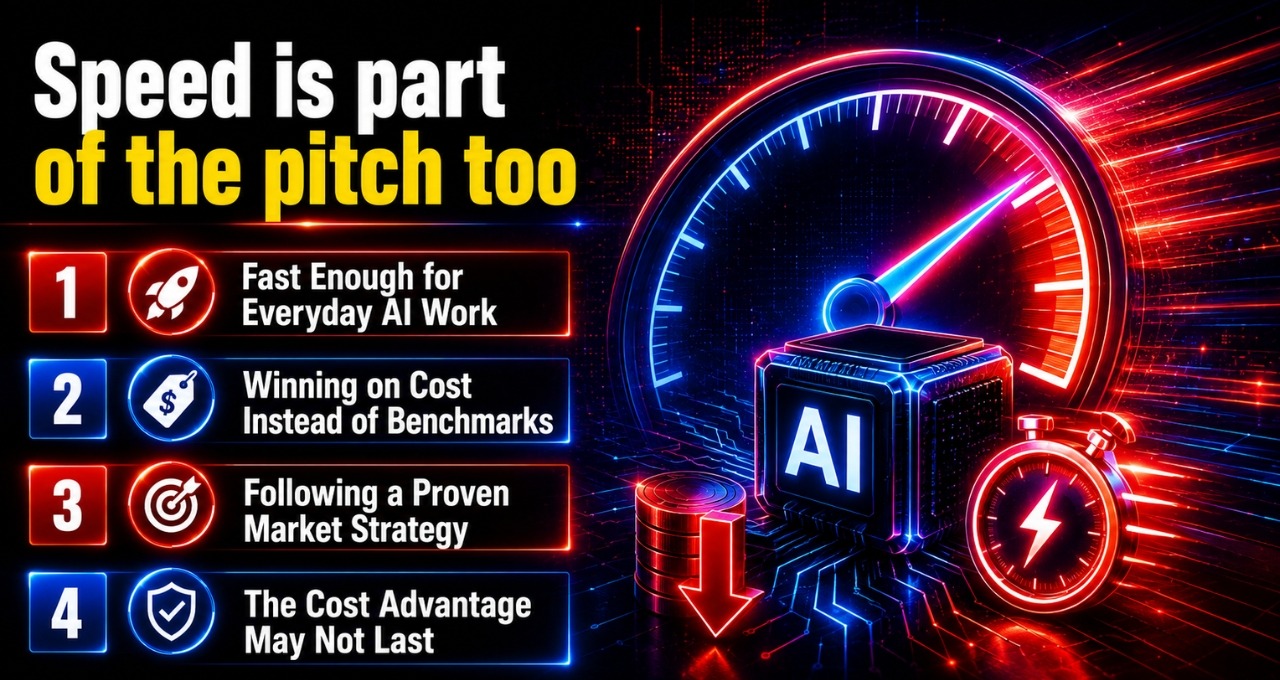
Speed is part of the pitch too
1. Fast Enough for Everyday AI Work
SpaceXAI is not positioning Grok 4.5 as the fastest AI model available. It delivers around 80 tokens per second, while independent testing by Artificial Analysis measured approximately 91.3 tokens per second. Although some competitors, particularly certain Cerebras-hosted models, generate responses much faster, Grok 4.5 still provides a smooth experience for interactive tasks like coding assistance, writing, and chat. For most users, this level of speed is more than sufficient, making performance a practical strength rather than a limitation.
2. Winning on Cost Instead of Benchmarks
Rather than competing solely on benchmark rankings, SpaceXAI is focusing on overall value. Grok 4.5 combines lower pricing with efficient token usage, helping businesses complete tasks at a reduced cost. Since it does not outperform premium models like Fable 5 or Opus 4.8 in raw intelligence tests, the company is shifting the conversation toward affordability and efficiency. This strategy encourages customers to evaluate AI based on operating costs instead of benchmark scores alone.
3. Following a Proven Market Strategy
SpaceXAI's pricing approach mirrors the strategy previously used by Chinese AI providers such as DeepSeek and Zhipu. These companies became competitive by offering models that were capable enough for most business applications while significantly reducing usage costs. Instead of aiming to dominate every benchmark, they attracted customers by delivering a strong balance between performance and affordability. Grok 4.5 appears to be following this same playbook.
4. The Cost Advantage May Not Last
Lower pricing can attract customers, but it is rarely a permanent competitive advantage in the AI industry. Major providers like Anthropic have a history of responding quickly with new releases or pricing changes, while OpenAI already offers lower-cost options such as its Luna tier with similarly priced output tokens. As competitors continue adjusting prices and improving their models, SpaceXAI will likely need to keep innovating beyond pricing alone to maintain its market position.
How ZTS Infotech Pvt Ltd. decides which AI tools are actually production-ready
Launch-day pricing and benchmark charts are a starting point, not a verdict — which is why ZTS Infotech Pvt Ltd. doesn't recommend a model to clients based on a vendor's release notes alone. The team runs its own workload-specific evaluations, testing each new model against the kinds of messy, real-world codebases and multi-step agentic tasks clients actually hand off, rather than relying on synthetic benchmark suites. Cost-per-completed-task, hallucination rate under sustained use, and how a model behaves across hundreds of tool calls in a row all get weighed against the sticker price before ZTS puts anything in front of a client's production stack.
Our CEO Mr. Anirban Das has been especially vocal internally about one thing: token efficiency claims need to survive contact with a real repository before they mean anything. His focus areas going into this cycle include reliability under long-horizon agentic tasks, data-handling terms buried in integration deals (like the Cursor-SpaceXAI data-use clauses now drawing scrutiny), and making sure clients understand the gap between a model's list price and its actual cost per successful outcome. Das has repeatedly pushed the team to treat "cheaper" and "production-ready" as two separate questions — and to only recommend a switch once both are answered with real usage data, not launch-week marketing.
FAQs
1. Is Grok 4.5 actually cheaper than Claude?
Yes, on a per-token basis. Grok 4.5 costs $2/million input tokens and $6/million output tokens, compared to $5 and $25 for Anthropic's Opus 4.8. But Anthropic's lineup includes cheaper models too, like Sonnet 5 and Haiku 4.5, so the comparison depends heavily on which Claude model is being replaced.
2. Does Grok 4.5 outperform Claude and GPT on benchmarks?
Not overall. Artificial Analysis ranks it fourth on its Intelligence Index, behind Claude Fable 5, GPT-5.5, and Opus 4.8. Its edge is efficiency — using far fewer tokens to reach comparable results on several coding and agentic benchmarks — rather than raw top-line performance.
3. Why did Grok 4.5's hallucination rate increase?
Artificial Analysis's testing found the model's accuracy on its Omniscience Index rose alongside its hallucination rate, which jumped from 25% to 54% compared to the prior Grok generation. The model appears to answer more questions confidently, including ones it gets wrong, which is a real consideration for unsupervised production use.
4. What's the connection between Grok 4.5 and Cursor?
SpaceX, which owns SpaceXAI, acquired the code editor Cursor for approximately $60 billion in mid-June 2026. Grok 4.5 was trained partly on Cursor's developer interaction data and now ships as a selectable model inside Cursor across all plans, alongside its own Grok Build agent.
Need more clarity? Click here and subscribe to us.
-

Writen by Anirban Das
