
Anirban Das
Founder & CEO
ZTS Infotech Private Limited (ZTS)
 USA:
+1 (213) 233-1633
USA:
+1 (213) 233-1633
 India:
+91-8910802928 | Email:
sales@ztsindia.com
India:
+91-8910802928 | Email:
sales@ztsindia.com
April 01, 2026
Business Growth Digital Solutions Global Innovation Scalable Web Development Technology & Innovation
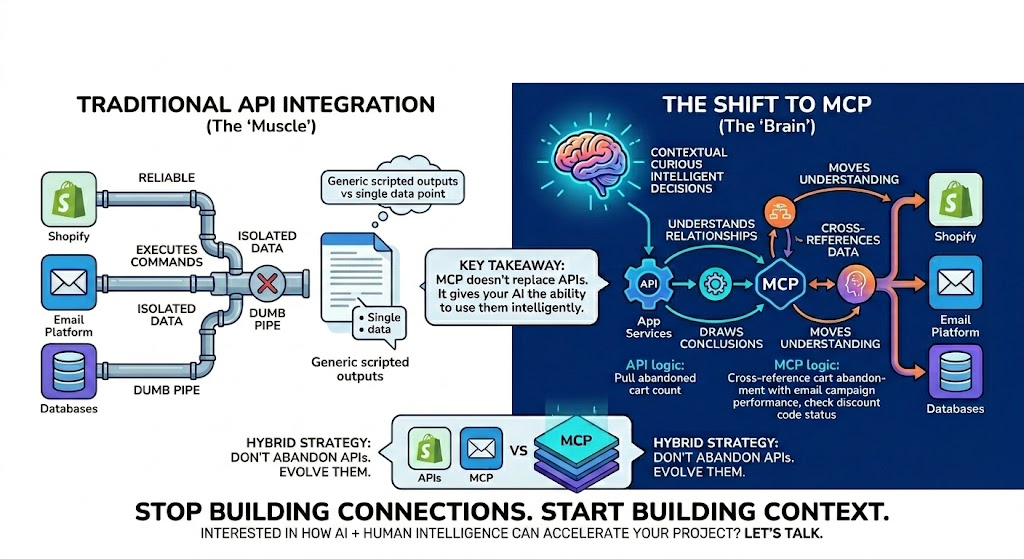
Stop building APIs. Start building AI context.
Let me ask you something uncomfortable.
When was the last time an API integration genuinely surprised you? Not impressed you with its reliability, actually surprised you with something you didn't expect?
If you're struggling to answer that, you're not alone. And that silence tells you everything.
Traditional API automation, our Zapier flows, your REST calls, your webhook chains, is muscle. Reliable, disciplined, impressively strong muscle. But muscle doesn't think. It executes. It does exactly what you told it to do, nothing more.
AI is a brain. Curious. Contextual. Capable of making connections across things that were never meant to talk to each other.
So what have we been doing? Wiring the brain directly into the muscle, asking it to behave like a dumb pipe. Feeding it isolated data, expecting intelligent output, and wondering why the responses feel generic every single time.
Key takeaway: An AI model without context isn't intelligent, it's just fast. Speed without direction is expensive noise.
Enter MCP - The Missing Piece Nobody's Talking About Loudly Enough
Model Context Protocol. If you haven't heard of it, write it down. If you've filed it under "things to explore later," move it to the top of the list.
MCP is a standardized language that lets AI models communicate with your tools, databases, and platforms, not just pull data from them, but understand them. Query them. Cross-reference them. Draw conclusions from the relationships between them.
Here's the difference in plain terms:
At ZTS Infotech, we've watched this shift happen in real time, and it's completely changed how we approach development projects. The teams winning aren't the ones with the most integrations. They're the ones with the most context.
Key takeaway: MCP doesn't replace APIs. It gives your AI the ability to use them intelligently, the way a human analyst would, not the way a script would.
A Real Scenario That Makes This Click
Your e-commerce client's conversion rate just cratered overnight. They're panicking.
The old workflow: Log into Shopify. Export data. Check the email platform separately. Dig through support tickets for clues. Spend two hours building a theory. Write a "here's what we think happened" email.
The MCP-powered workflow: Your AI has the Shopify MCP and your email platform MCP connected. You type: "Why did conversions drop 40%? Cross-reference cart abandonment rates by traffic source and check if anything changed in the checkout flow in the last 12 hours."
Within seconds, the drop is concentrated in mobile traffic from email campaigns. Abandoned carts spiked specifically at the payment step after 6 PM. A promo code referenced in the email blast had quietly expired at 5:45 PM.
Expired coupon. Identified. Fixed. Done, before your client's second message hits your inbox.
That's not a productivity hack. That's a competitive edge.
Nobody is saying throw away your existing integrations. APIs are still the backbone of reliable, high-volume automation. They're fast, cheap per transaction, and battle-tested.
The hybrid approach is simple:
APIs handle the pipes. Syncing contacts, triggering workflows, pushing notifications when a threshold is crossed, all of this still belongs to the API layer. Efficient, automated, invisible.
MCP handles the playbook. Any time you need your AI to reason across multiple data sources, draw comparisons, and generate insight rather than just output, that's where MCP earns its place.
Key takeaway: The worst thing you can do right now is use AI for things APIs do better, and APIs for things AI was built for. Know your tools. Layer them correctly.
The Bottom Line
APIs were the competitive edge of yesterday. They're the baseline of today. If you're still treating them as the ceiling of what's possible, you're building a ceiling into a space that no longer has one.
MCP and the shift toward AI context architecture are the next layer. It's not experimental anymore. It's here, it's working, and the teams adopting it are already delivering results that look like magic to anyone still living in the API-only world.
At ZTS Infotech, we've built our entire development philosophy around one idea: the most powerful products aren't built by choosing between human intelligence and artificial intelligence, but by designing systems where both work at full capacity together.
Stop building connections. Start building context.
That's where the real work begins.
Interested in how AI + Human Intelligence can accelerate your next web or mobile app project? Let's talk.

ZTS Infotech Private Limited (ZTS)
Partner with us to redefine


